Commercial Roofing in Burlington, WA
Commercial roofing in Burlington, WA at the I-5 and SR 20 interchange: large-format retail roofs, drainage on flat ground and repairs priced by line.
Commercial Roofing in Burlington, WA
Commercial roofing in Burlington, WA at the I-5 and SR 20 interchange: large-format retail roofs, drainage on flat ground and repairs priced by line.
Service Areas
Burlington in Bellingham
A big retail roof that sits quiet still leaks. Burlington, WA is in Skagit County with 9,152 residents in 2020, and its Cascade Mall opened in 1989 at the I-5 and SR 20 interchange and closed in June 2020. A closed or partly used building keeps its roof, its drains and its flashings, and none of them stop working because the doors slow down.
That makes large-format retail and interchange buildings the natural fit here, and each roof needs a clear read of what it has. Dikes protect the city from Skagit River flooding, so the ground is flat and water has a short path to wherever the roof sends it. We start with the drainage.
Overview
Burlington
Flat ground, flat roofs
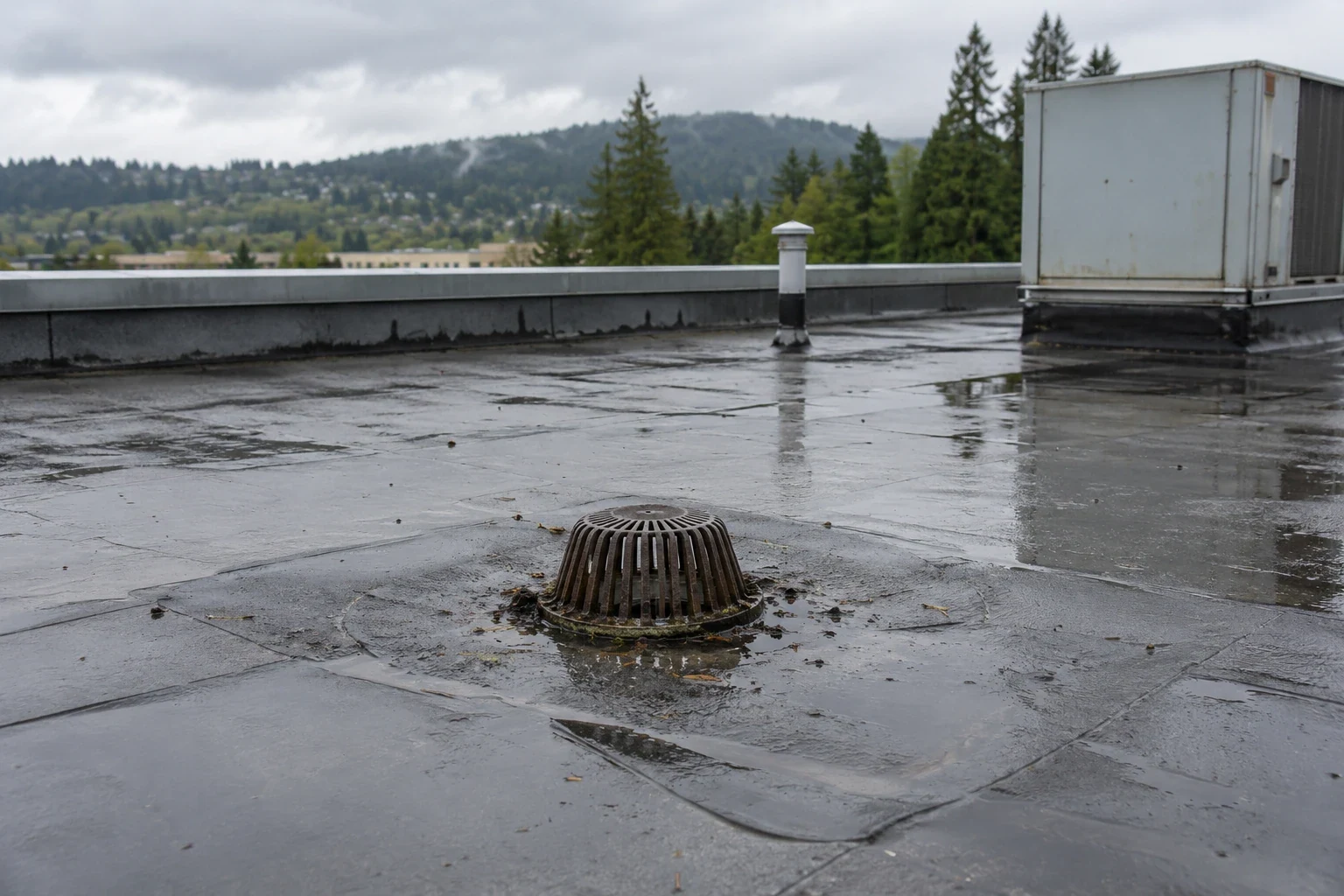
Flat land and flat roofs go together. A low-slope roof sheds water to drains and scuppers, and if those clog, the roof becomes a shallow pond. Standing water ages membranes, loosens seams and loads the structure. On a wide roof, the weight is real.
We map the drainage on a first walk. We pour water at the drains to check flow. We shoot elevations where ponding shows. We count drains against the roof area and note any that are blocked, undersized or missing. A drain and scuppers fix is often the cheapest repair on the list.
Where ponding is chronic, tapered insulation or added drains solve it. Tapered boards are drawn board by board and fit during a reroof or a recover. Neither is a patch job.
Scuppers and overflow drains are the safety valve. If the main drains clog, an overflow lets water leave before the roof overloads. We check that overflows exist, sit at the right height and are not blocked by debris or sealant. A roof without a working overflow is one clogged drain from a structural problem.
Dikes and flat ground also mean groundwater and humidity stay high. Moisture inside the building reaches the roof deck from below, and condensation shows up as stains that look like leaks. We check vapor retarders and ventilation before blaming the membrane.
Roofs on buildings with less traffic
When a building has reduced activity, the roof loses its routine. No one clears drains. No one reports a stain. A small leak runs for months before anyone sees it. The roof's condition is unknown until someone walks it.
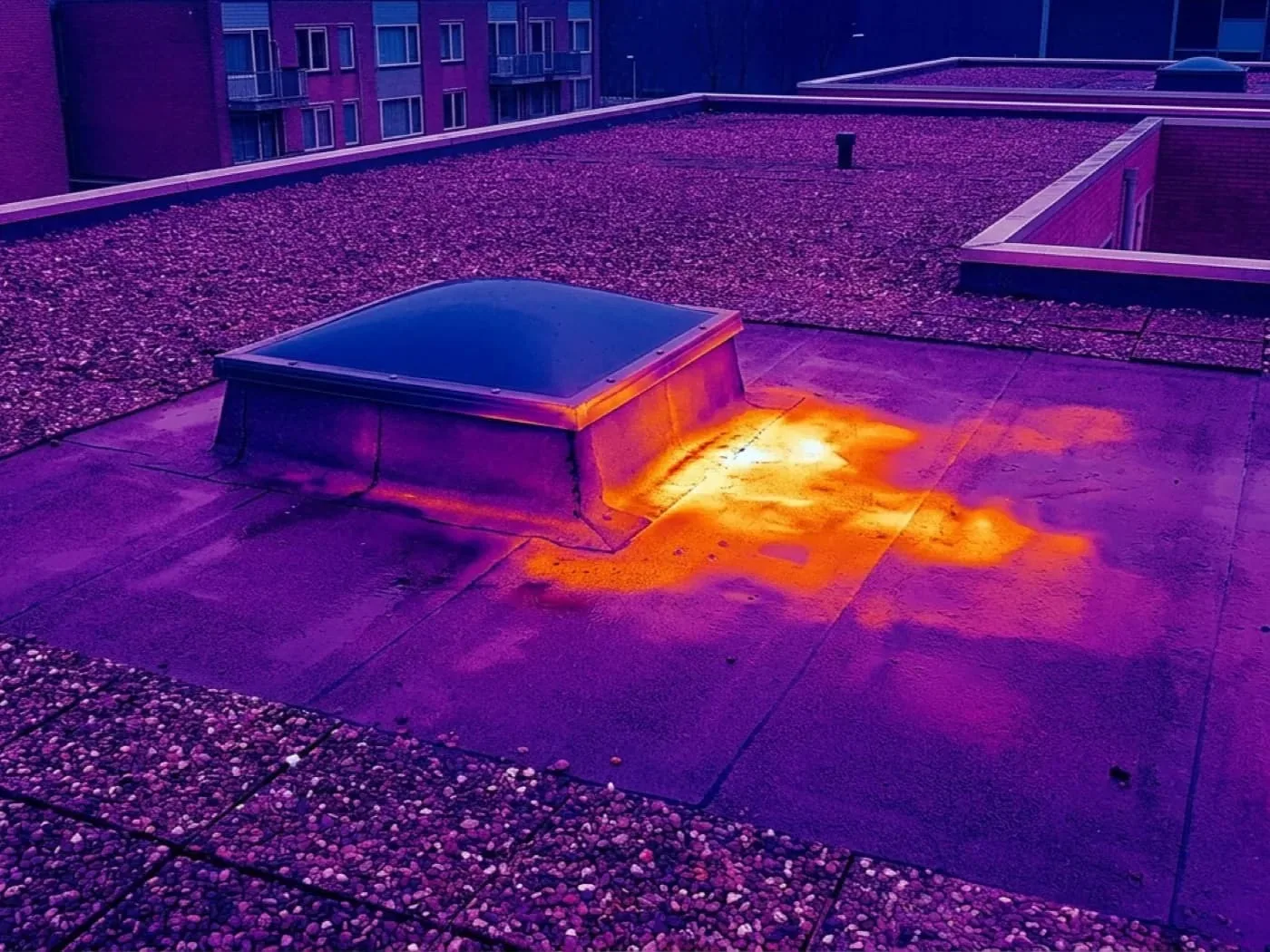
We read what each building has: membrane type, seam condition, fastener backout, flashing movement and moisture in the insulation. A moisture survey maps wet zones on a large roof quickly, and a drone covers the surface without putting a person on wet membrane.
Drone images of a large flat roof are logged by date, which lets the owner compare ponding patterns from one rainy season to the next, and cores confirm moisture at selected points. The result is a condition report with photos, grades and a ranked list. A buyer, a lender or a new tenant can read it and decide. For owners deciding whether to restore or replace, the report supplies the numbers. Our due diligence surveys follow the same approach with a closing calendar.
Reuse changes roof needs. A building converted from retail to another use may add rooftop equipment, change its interior humidity or gain new penetrations. Each change touches the roof. We ask what is planned inside before we quote work outside, since a new unit placed after a new roof voids the fresh warranty if nobody told the manufacturer.
Interchange buildings and the freight corridor
I-5 is the main north-south freight corridor of the region, and SR 20 meets it at Burlington. A building near a freight interchange sits in traffic noise and road dust, and fine grit settles on membranes and into drain screens.
Roof access matters at interchange sites. Trucks, loading areas and tight parking all affect where a crane or lift can stand. We plan staging on the first walk and book the equipment early. A lift day lost to a blocked lot costs the whole crew.
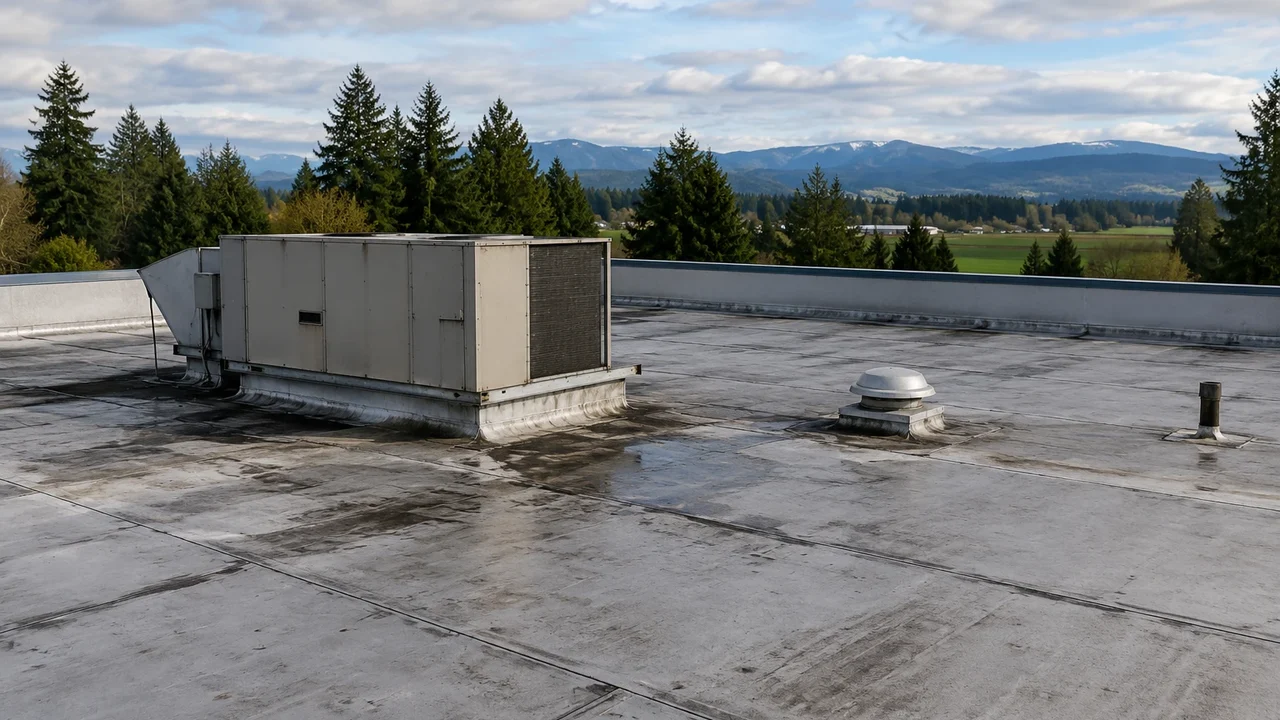
A large-format building can carry many rooftop units. Each unit sits on a curb or rail that needs flashing. Our curb and support work counts every one and lists it as a line.
Climate and the dry-in calendar
Numbers from Bellingham, the market city, give only a guide: about 34.8 inches of rain and roughly 1,866 sunlit hours a year. Skagit County has weather of its own. We plan with float and avoid promising dates in the wet season. Installs aim at summer, because welding, adhesives and coatings need dry surfaces. Wind is the edge question. Gusts in Bellingham reached 67 mph in March 2016, and the November 2024 bomb cyclone's easterly wind crossed Sudden Valley. Large flat roofs catch wind at the perimeter, so fastening density rises there and we test the edge metal by hand.
Moss and algae need a cleaning plan on any shaded or damp flat area. Growth holds water against the membrane and hides defects. A wash and a biocide treatment go on the maintenance schedule, and we check the surface underneath after each cleaning.
Repair, restore or replace
Three options sit on the table. Repair keeps a sound roof sound. Restoration, such as a silicone coating or a recover, extends life. Replacement resets the clock.
Moisture decides. A dry assembly with a tired surface suits restoration. A saturated one points toward replacement. Where the roof allows, the choices are priced side by side.
Code enters a replacement. A new roof follows the insulation levels of the current state codes, in force since March 15, 2024, which often raises curbs and wall flashings. The design team confirms what applies, and we carry the heights into the estimate.
Phasing is available on large roofs. A building can be restored in sections over two or three summers, with the worst areas first. That spreads the cost and keeps the rest of the roof in service. We draw the sections on the plan and price each separately.
What drives the number
Roof area and system set the base. Drainage corrections and equipment curbs add lines. Access and staging add another. The calendar moves the number too, because dry-month work costs less than wet-month work.
Neighboring cities share some of these drivers. Mount Vernon and Sedro-Woolley sit on the same I-5 and SR 9 and SR 20 network, and several sites on the route get grouped into one trip. A multi-site program turns that grouping into a standing schedule.
Commercial Roofing Questions
Does a quiet building need roof attention?
Yes. Drains clog, flashings move and leaks run unseen. A first walk gives the owner a current picture. We then set a visit cycle that fits the use of the building.
How do you handle ponding on a flat roof?
We map it, check the drains and shoot elevations. Fixes range from clearing a drain to adding tapered insulation. The right one follows the cause.
Can a moisture survey cover a very large roof?
Yes. Infrared scans cover large areas quickly on the right evening. Cores confirm the readings at selected points. The result is a map the contractor can bid from.
What does the energy code change on a replacement?
Insulation levels, mostly. A thicker stack raises every flashing. The design team confirms the requirement, and our estimate carries the added height as its own line.
Can several Skagit County roofs be handled together?
Yes. We group sites on the same corridor to cut travel and mobilization. Owners with more than one building save the most.
Send the roof plan and the drain locations
Send the roof plan, any past leak notes and your target window. We will price the walk, the repairs and the options as separate lines before the bid closes.