Roofing for Logistics and 3PL Operators in Bellingham, WA
Roof planning for logistics and 3PL operators in Bellingham, WA: dock-door leaks, border-freight schedules, rack protection and wet-season dry-in rules.
Roofing for Logistics and 3PL Operators in Bellingham, WA
Roof planning for logistics and 3PL operators in Bellingham, WA: dock-door leaks, border-freight schedules, rack protection and wet-season dry-in rules.
Industries We Serve
Roofing for Logistics and 3PL Operators in Bellingham
A dock door seal is a roof detail too. Water that runs off a roof edge lands at the dock, and a trailer backing into a puddle tracks it into the building. In Bellingham, WA the roof and the dock fail together. Rain comes to about 34.8 inches a year, the peak lands in November, and a sun-poor climate keeps edges damp. A distribution building here has its roof tested for most of the year.
Logistics runs on throughput. A leak over racking is a claim. A closed bay is a late load. We schedule roof work around peak weeks and holiday volume, and we price the dock-side details as their own lines.
A plant that ships through a 3PL building shares its roof risk, so the thinking in our manufacturer work carries over. Retailers who receive from these buildings, the retail and restaurant chains, feel a closed bay at their own docks.
Overview
Roofing for Logistics and 3PL Operators
The freight map
Interstate 5 is the main north-south freight corridor. It runs through Bellingham, Ferndale and Blaine and ends at the Canadian border. The Guide Meridian, SR 539, runs from Bellingham to Lynden and the border, meeting I-5 at Bellis Fair. SR 9 runs north to Sumas and its port of entry, open 24 hours a day. BNSF rail runs through Ferndale. The Bellingham Shipping Terminal handles rock barged to the Columbia River and scrap metal exported by ship. Cross-border trade with British Columbia carries much of the county economy, and roughly 65 percent of Bellingham International's customers are Canadian.
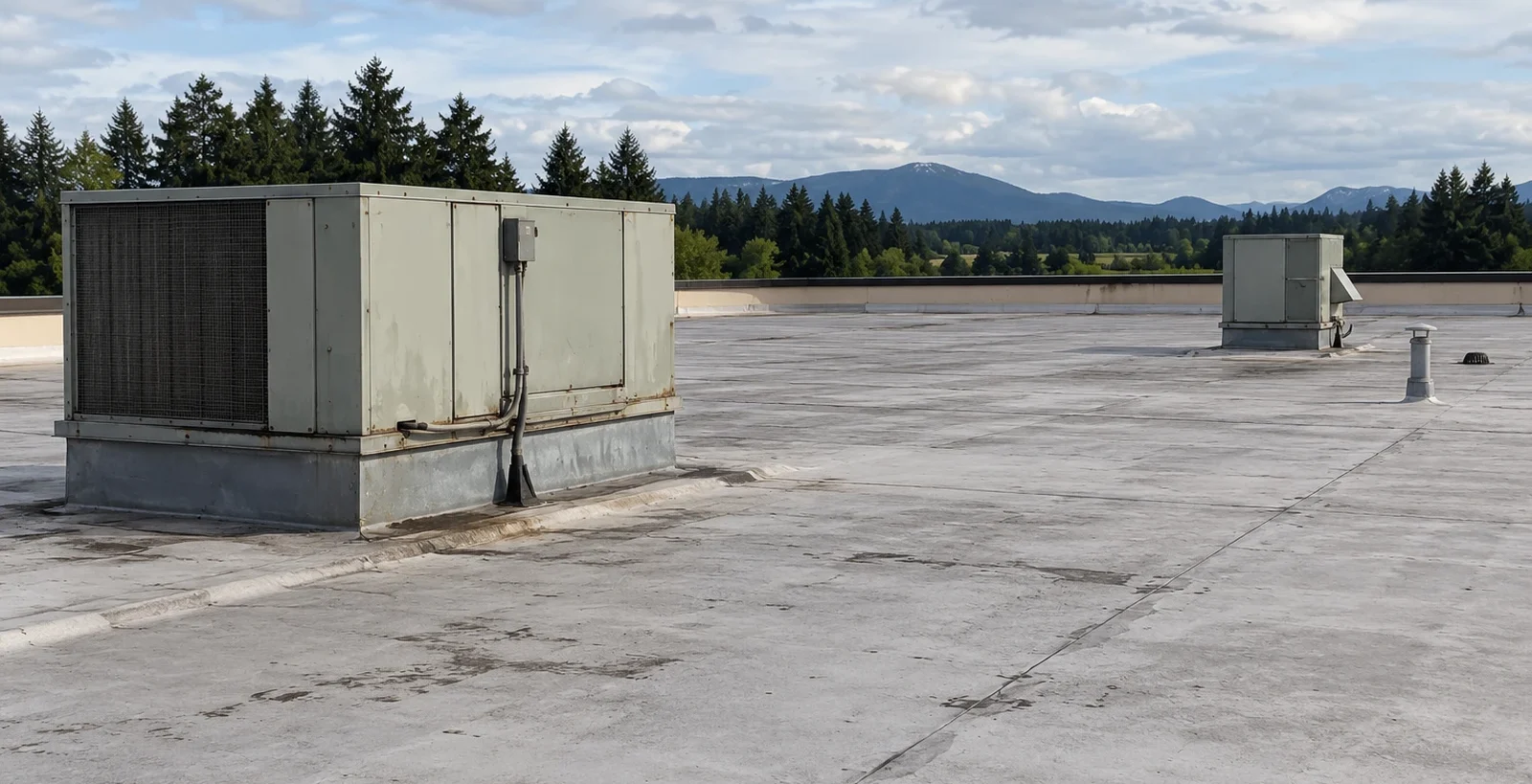
That map puts distribution buildings along several routes. A large low-slope distribution roof has the same weak points anywhere: the edges, the dock canopies and the few drains.
Border freight adds a rhythm. Trucks queue at crossings, and loads back up on certain days. A building near the corridor sees that rhythm in dock traffic. We schedule roof work for the quiet gaps and keep haul routes off the truck court.
Pricing a building on the corridor is straightforward. Roof area. Drain count. Dock count. Edge footage. Access. Each is a line. The operator adds them up and compares the repair against a coating or a replacement.
Docks, canopies and edges
Dock canopies take hits. Trailers strike them. Forklifts splash water across them. Edge metal along the dock wall loosens. We check canopy flashing, scupper discharge and downspout routing over truck courts. Water that leaves a roof onto concrete where trucks maneuver is a safety issue, not only a roof issue.
Wall-to-roof joints matter. Sealant at tilt-up panel seams fails. A gap behind the roof edge shows up as a stain in the racking aisle. These are cheap in a maintenance visit and costly after a customer's stock gets wet. Our distribution center roof program makes them routine.
Truck exhaust leaves a film. Diesel soot and splashed grit gather on canopies and parapets, and they hide hairline cracks until a hard rain. A scheduled wash and inspection of those edges, with sealant renewed where joints opened, protects the first rack row inside the wall.
Racking, sprinklers and stock
Water above racking is not the same as water above a floor. It runs down a column of pallets. Product stored high is hard to reach. Sprinkler pipe hanging from roof structure corrodes in persistent damp, and a roof that sags under ponded water loads the structure that holds the system.
So drainage matters most on big, simple roofs. A handful of drains serve a wide area. One blocked outlet ponds several bays. We clear drains and verify overflow paths with drain and scupper work. We also log every penetration for sprinkler risers, smoke vents and hatches. Changes to those go through the fire-protection contractor, and we flag them so an unrelated repair does not disturb them.
Light panels and skylights over a pick floor are useful, but their curbs are weak points. We inspect gaskets, domes and flashing at each, and we recommend infill with insulated roof where the daylight is no longer needed and the opening is a leak risk.
Wind across open lots
Distribution buildings sit on open ground with long clear approaches. Wind has room to build. Bellingham gusts reached 67 mph in March 2016, and a bomb cyclone in November 2024 sent damaging easterly winds through Sudden Valley. A big, flat roof with a weak perimeter loses sheet fast.
The perimeter gets the most attention. We check coping, edge metal and termination bars on each visit. Fastening goes on the bid by the foot. Large roofs near the I-5 and SR 539 interchange, around Bellis Fair, share that exposure. After a blow, the fastening record tells the carrier what was storm damage and what was wear.
Snow rarely stops a dock. Snow here totals roughly 10 inches a year, almost all of it December through February. But ice at a scupper discharge over a truck lane is a hazard. We size openings with room to spare and route discharge away from foot and vehicle paths.
Peak season and the dry window
Logistics has peaks. Holiday ramp-up lands in the wet months. Roof work in that window fights for dock space, parking and attention. So major work goes into the shoulder months, with single-ply systems like TPO that install fast on open decks. July is the driest month and the best window.
Crews stage materials away from truck courts, keep fire lanes clear and leave dock doors usable. For operators with several buildings, multi-site roof programs group roofs by condition and lease date, so a peak season, a lease expiration and a replacement do not land in one quarter. Washington's 2021 energy code, effective statewide March 15, 2024, may raise insulation on a replacement. We price it in.
Parking and truck courts matter during a job. Cranes and lifts need space. Trailers need clear approaches. We lay out a staging plan with the operations manager, mark material zones and agree on hours that keep gate traffic moving.
Records customers ask for
A 3PL building often stores more than one client's goods. A leak can touch several accounts. Our report maps which bays sit under which roof section. The operator can tell a client what was exposed and what was not.
Some 3PL agreements require the operator to keep the premises weather-tight. A dated roof program is evidence that the duty is met. We keep inspection dates, photographs and repair records in one place so an account manager can answer an audit question in minutes.
At turnover, the file helps. A new tenant or an acquirer reads the roof history in a few pages. Dated photographs. Repairs by location. The next recommended step. It answers the first questions before they are asked.
Commercial Roofing Questions
Can you reroof a warehouse while it ships product?
Generally yes. Work moves in sections, with weather-tight closure each day, overhead protection where needed and staging kept off truck courts and fire lanes.
What should an operator check after a heavy rain?
Dock-door corners, the first rack row inside each canopy and any floor or ceiling stain. Those spots show roof and wall problems early.
Do lease terms decide who pays for the roof?
Often. The allocation varies by lease. We supply the condition report and cost ranges for both landlord and tenant.
How does a hot or damp roof affect stored goods?
Damp is the bigger issue here. A leak wets cartons, and persistent humidity under a poorly drained roof can harm paper goods. Dry drainage fixes most of it.
Are roofs near the airport treated differently?
Wind exposure is open, and drone flights near the field need coordination with airport operations. We plan around both.
Send building sizes, ages and peak dates
Send the building list, lease timelines and your busiest weeks. We will grade each roof and schedule priced lines around volume.