Commercial Roof Replacement in Bellingham, WA
Full tear-off and replacement for Bellingham, WA commercial roofs, priced in separate bid lines and sequenced into the dry months so the deck stays protected.
Commercial Roof Replacement in Bellingham, WA
Full tear-off and replacement for Bellingham, WA commercial roofs, priced in separate bid lines and sequenced into the dry months so the deck stays protected.
Commercial Roofing Services
Commercial Roof Replacement in Bellingham
A tear-off leaves the building under a tarp and a forecast. In Bellingham, WA, the forecast usually says rain. November is the wettest month, and the year totals about 34.8 inches. We plan every replacement around that fact. The crew strips only the area it can dry in before dark. That daily area sets the crew size, the calendar and the number at the bottom of the bid.
Send us the roof plan, the age of the current system and any moisture findings. We price the strip, the deck, the insulation and every metal line before the bid closes. The general contractor then sees which days carry risk and which carry none.
Overview
Commercial Roof Replacement
What comes off first
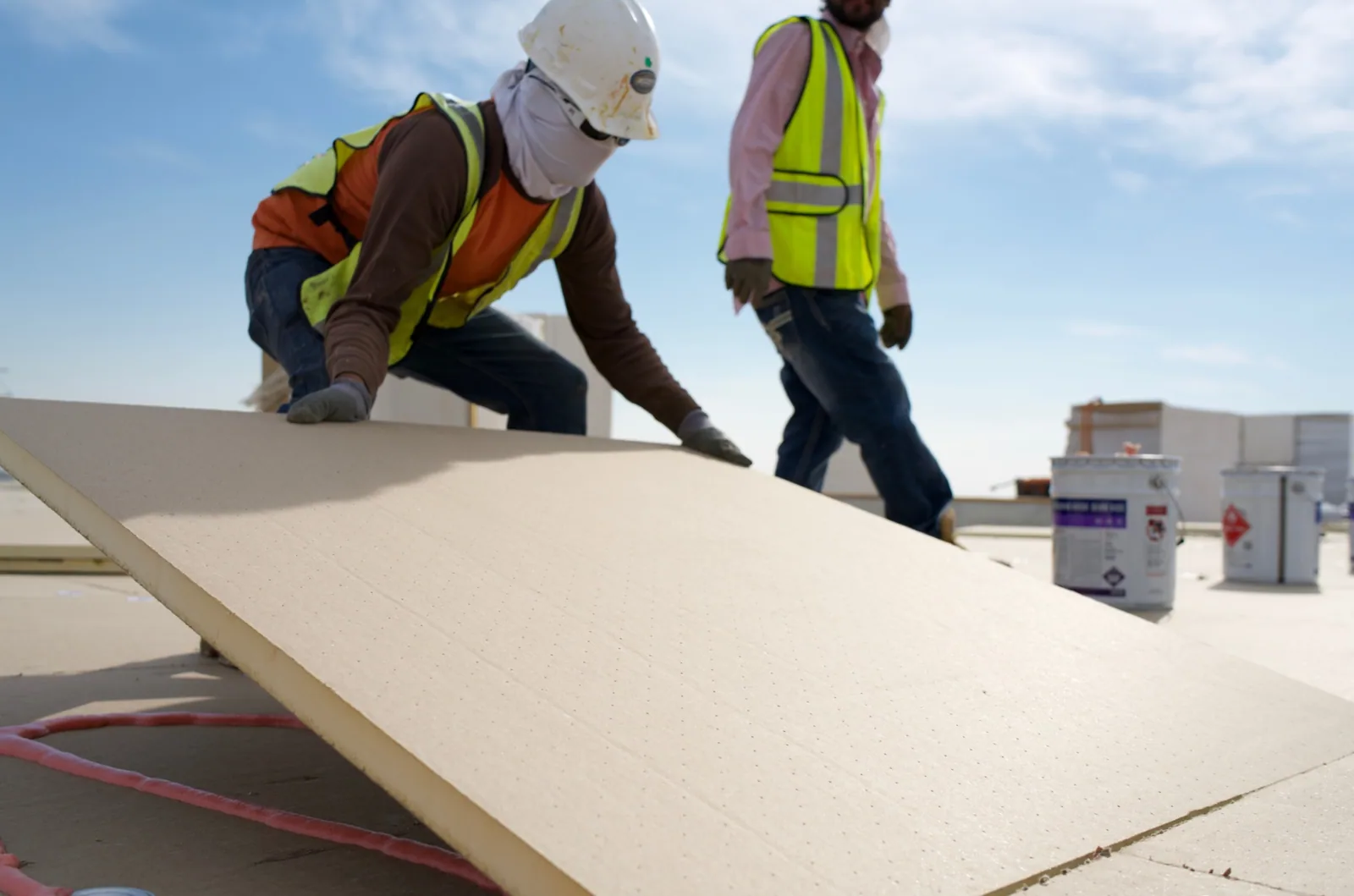
The membrane comes off first. Then the insulation. Then we look at the deck. A probe check across the field shows which board holds water and which stays dry. Insulation that holds water does not go back under a new membrane. It is cut out, hauled away and replaced. Deck panels with rot or rust get their own line. We do not guess those quantities from the street.
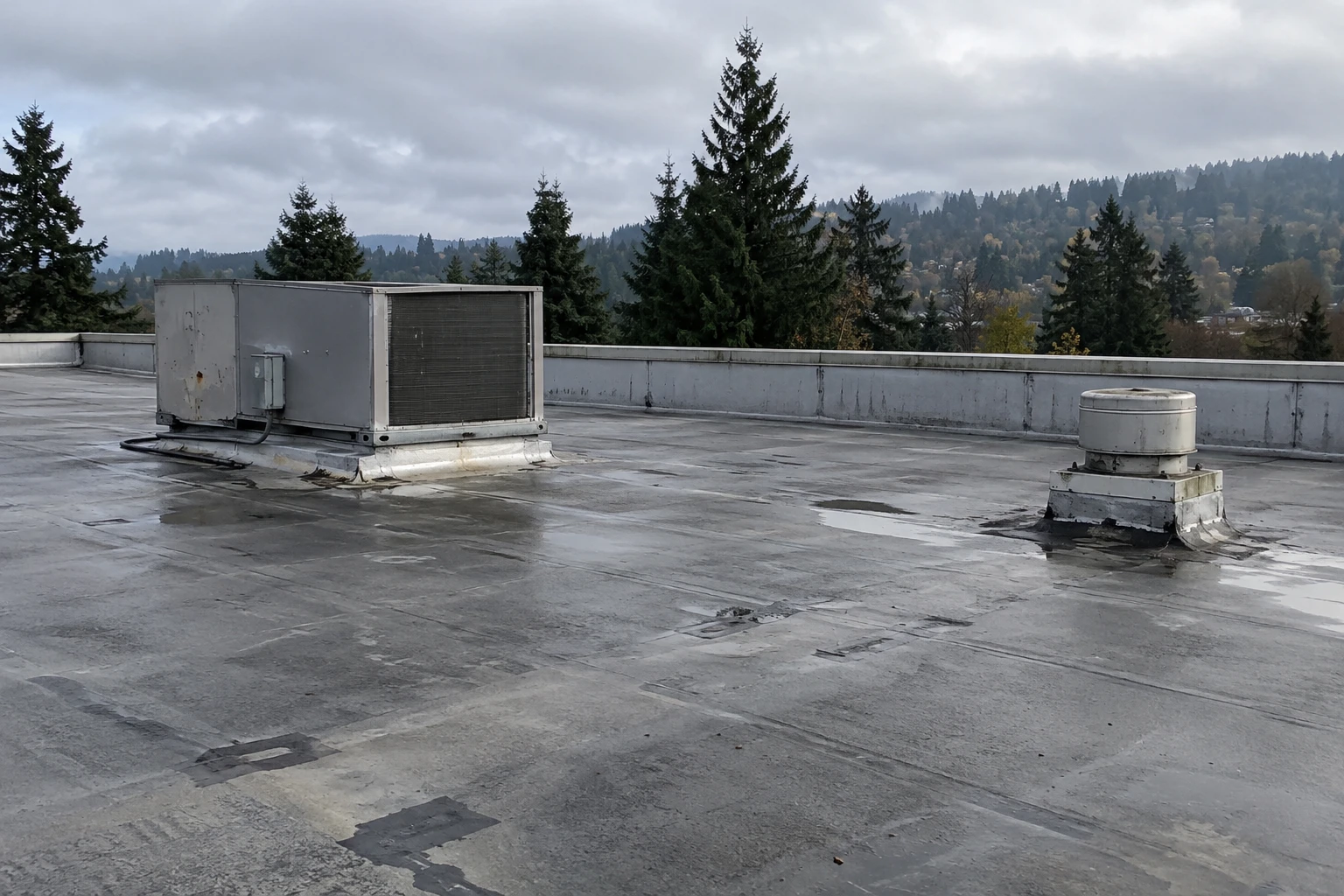
Gravel-surfaced and built-up roofs add weight and haul-off time. Single-ply systems such as TPO strip faster but still leave adhesive and fasteners to clear. Either way, the deck must be clean and dry before the first new sheet rolls out. A damp deck under a fresh membrane hides the problem for the next owner to find.
What it costs
Four items move the price more than the membrane does. They are deck repair, insulation thickness, edge metal and access. Deck repair stays unknown until the tear-off starts, so we carry an allowance and a unit rate. Insulation follows the 2021 Washington State Energy Code, in force statewide since March 15, 2024. That requirement grows or shrinks the insulation line. Edge metal is mostly labor. A long perimeter of coping cap costs more to set than to buy.
Access is the fourth item. A building with open yard space hoists material one way. A building on a tight street hoists it another way. Crane time, lift time and haul-off trips all land on the bid. Tell us where the truck can stand, and we price the real route. A cover board and insulation package gets its own line, so a thickness change never reprices the membrane.
Build it in summer
July is the driest month in Bellingham. We aim to have terminations and metal closed before the fall rain settles in. Bellingham sees only about 1,866 sunlit hours in a year. A damp deck dries slowly under that sky. One lost morning to dew or drizzle can cost a full dry-in day. On a spring or fall start, we carry weather days on the calendar and say so before the contract is signed.
Moss lines on an old roof mark where water sat longest. Low sunshine feeds moss and algae, and those patches are where we probe first. Expect more deck repair under them. A summer start on the Marine Drive waterfront or at an airport industrial building keeps the long dry window for the metal work, which is the part that cannot be rushed.
Bid lines
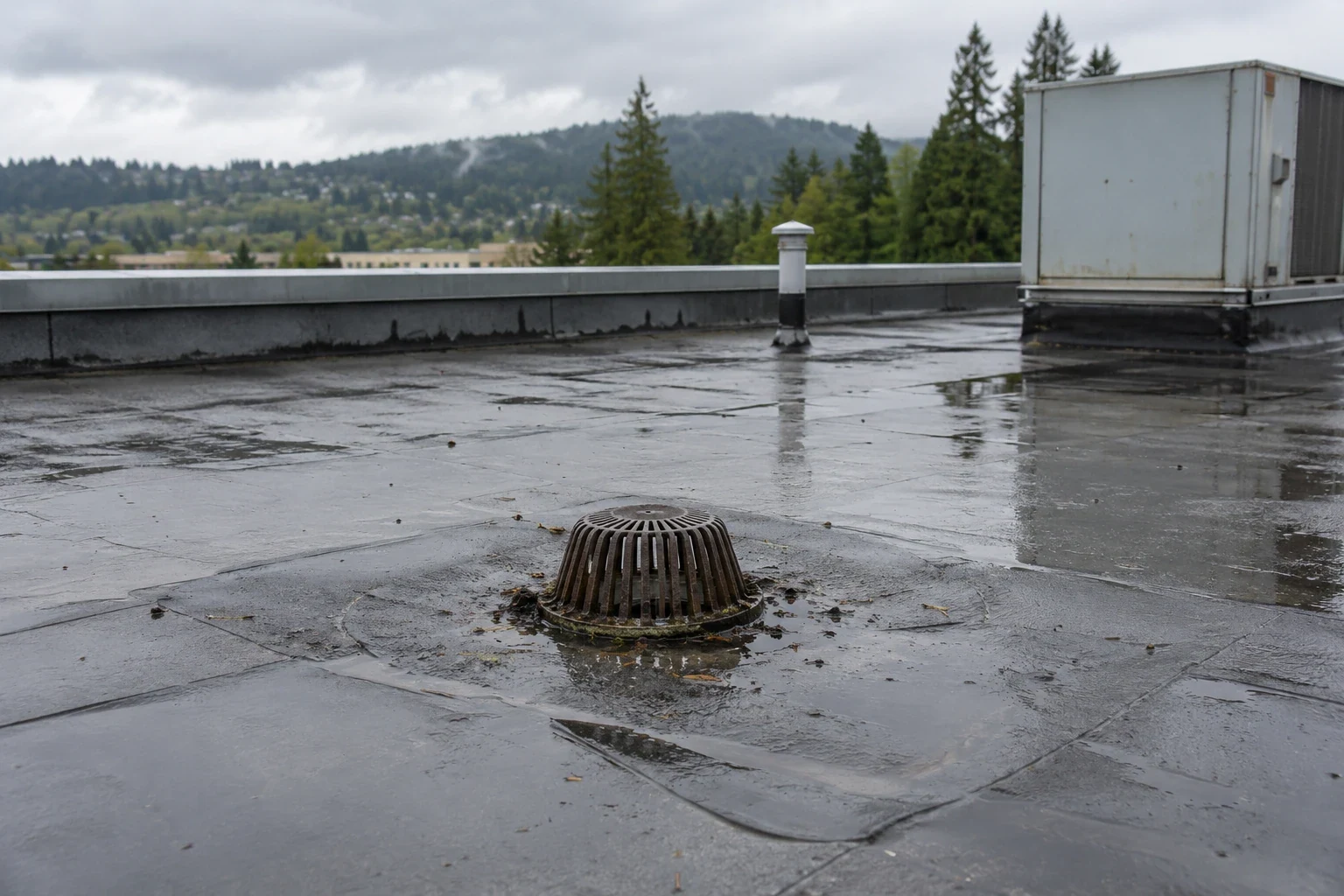
We split the bid so each cost has its own line. Tear-off and disposal. Deck repair allowance. Insulation and cover board. Membrane and seams. Edge metal and coping cap. Drains, scuppers and crickets. Curbs and penetrations. Probe checks and the punch walk. A general contractor can move any line to a later phase without repricing the rest.
Terminations tend to vanish inside a lump sum, so we pull them out. Counterflashing, reglet cuts and base flashing height are labor-heavy. They decide whether the roof closes in one dry window or two. When the submittal calls for a specific coping profile, send it early. Formed metal has a lead time, and a late profile can push the start past the dry season. Planning drains and scuppers in the same pass keeps the crickets and slopes consistent.
Wind and edges
Gusts reached 67 mph in March 2016 and stripped stucco from the Home Depot storefront in Bellingham. In November 2024 a bomb cyclone drove easterly winds through Sudden Valley, and at least 16 homes there were damaged. Wind finds the edge first. A loose coping cap or a thin row of perimeter fasteners gives it something to lift.
We fasten the perimeter tighter than the field. We set the cap on a continuous cleat. The 2021 International Building Code, in force statewide since March 15, 2024, governs the design wind loads, and the edge detail on the drawings should match it. Bring the spec early. A repair after a windstorm costs more than an extra fastener row ever did. The edge metal and coping scope is where that row gets priced.
Punch and closeout
The roof is not done when the membrane is down. It is done after the punch walk. We go over every seam, termination and drain with the general contractor, mark each item and close it. Weld probe checks come first, then flashing, then metal. Photos of the finished details go to the closeout file.
Occupied buildings change the last week. Tenants need clear entries, working drains and quiet hours around sensitive rooms. Healthcare is a major roof user in Bellingham, led by PeaceHealth St. Joseph Medical Center. A hospital roof adds noise and access limits, so those go on the schedule early. The sequence for reroofing an occupied building follows the same bid lines, with added days for protection and staging.
Commercial Roofing Questions
How many dry days does a tear-off need on a mid-size roof?
The area dried in each day sets the count. A crew that strips and covers a defined section by dark can run through a light shower without opening the building. We add weather days after July, because the deck dries slowly under Bellingham's low sunshine. The bid shows the dry-in days and the buffer separately.
Can we recover over the old membrane and skip the strip?
Moisture readings settle that question. If the core cuts and the infrared scan show a dry assembly, a recover over the existing roof may fit and saves the tear-off cost. If the insulation holds water, it has to come out. We run the survey first and price both paths on request.
What pushes a start date past the dry season?
Lead time on formed edge metal is the usual cause, followed by late submittals and unresolved deck findings. Insulation and membrane ship faster than custom coping. Send drawings, the roof spec and your target dry-in window early, and we can order the long items before the contract closes.
How does the state energy code change the insulation line?
The 2021 Washington State Energy Code took effect statewide on March 15, 2024. A full replacement reopens the insulation question, so the thickness on the drawings governs the line. We price that thickness and any tapered pieces separately from the membrane, so a change in R-value moves one number.
Who calls it when rain shows up on the forecast?
We call it. The site lead checks the deck and the sky each morning and decides how much roof to open. If the answer is less than planned, the general contractor hears that the same morning, along with what moves on the schedule. Nothing gets left open to hold a date.
Send the drawings and the dry-in window
Send the roof plan, the spec and your target dry-in window. We will price every termination, metal line and deck allowance before the bid closes.