TPO Roofing in Bellingham, WA
TPO single-ply roofing in Bellingham, WA: hot-air welded seams, wind-rated attachment and an install schedule that respects the long wet season.
TPO Roofing in Bellingham, WA
TPO single-ply roofing in Bellingham, WA: hot-air welded seams, wind-rated attachment and an install schedule that respects the long wet season.
Roof Systems
TPO Roofing in Bellingham
A TPO seam is only as good as the weld and the day it was made. Hot-air welding needs a dry sheet and a steady crew. In Bellingham, WA, where November is the wettest month and a damp deck dries slowly, that makes the calendar a bid item, not a footnote.
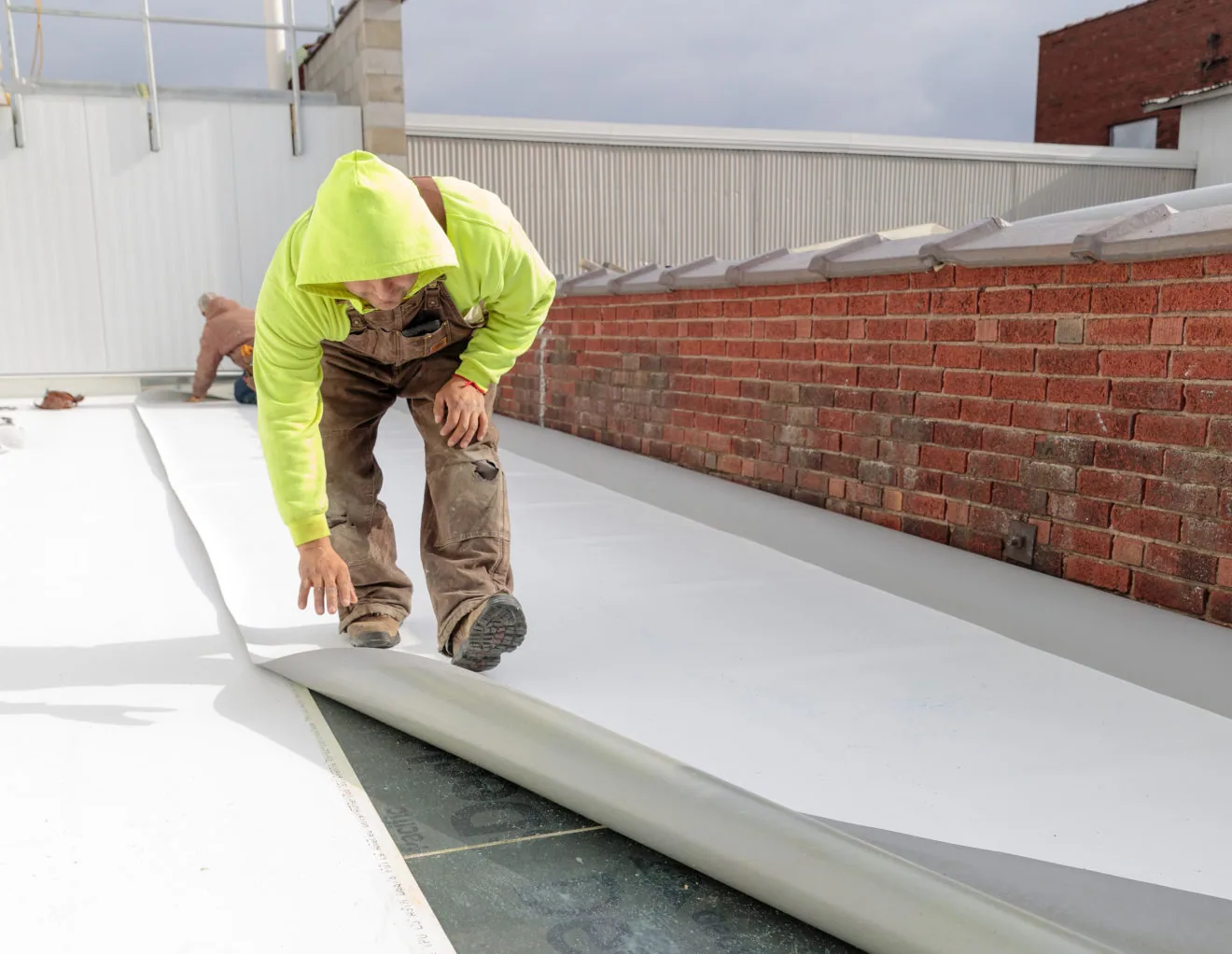
TPO is a single-ply thermoplastic membrane, white or light gray, welded into one continuous sheet. It is fast to lay, light on the structure and widely specified. It also rewards careful detail work, since the field is easy and the terminations are where the cost sits. We price both the sheet and the detail.
Overview
TPO Roofing
What the sheet is
TPO blends polypropylene and rubber into a flexible sheet, usually reinforced with a polyester scrim. Rolls come in widths from a few feet to well over ten. Wider rolls mean fewer seams, and fewer seams mean fewer places to fail.
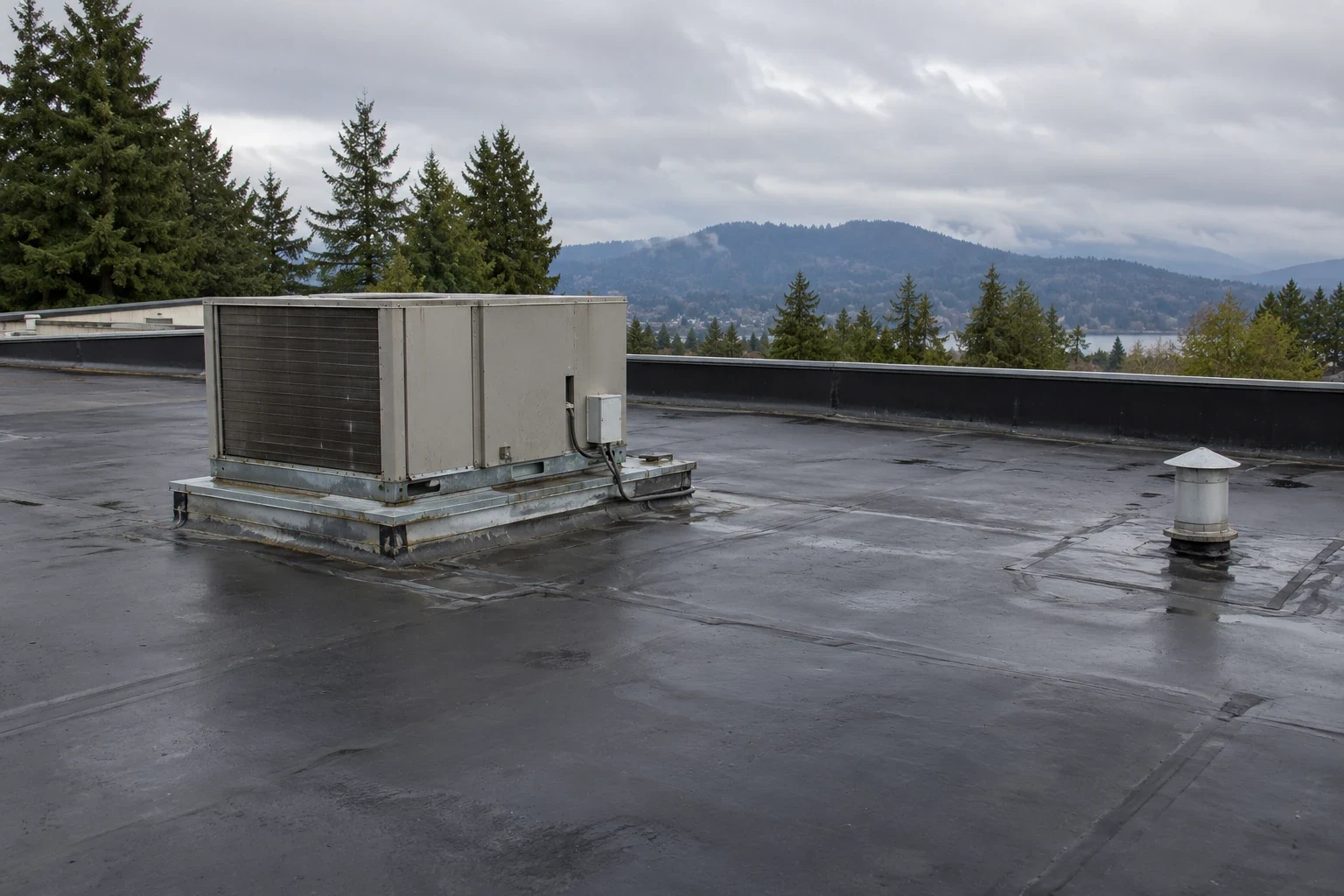
Thickness runs from thin sheets for light-duty work to heavy sheets for traffic and hail exposure. A thicker sheet costs more, and it also tolerates foot traffic from the mechanical trades. On a roof with many rooftop units, the heavier sheet usually earns its price.
The surface is reflective, and Bellingham sunshine is limited, so the cooling benefit is modest. The reason to pick TPO here is more often the weld, the weight and the lead time, not the color.
Compared with its single-ply cousin PVC, TPO usually costs less and resists grease and chemicals less. Compared with EPDM, it welds rather than glues, which gives a stronger seam. We price the three side by side when the spec leaves the choice open, and the owner sees what each adds.
Reroofing over an existing membrane brings its own check. Some old coatings and asphaltic materials do not get along with TPO, and a separation layer goes between. We identify the old roof type with a core sample before ordering.
The weld and the probe
Seams are fused with a hot-air welder that melts the two sheets together at the overlap. A good weld shows a small bead of melted material along the edge. A cold weld looks fine and peels with a fingernail.
We probe every seam. A thin steel probe is drawn along the edge, and any gap or soft spot is marked and re-welded. Probe checks run the same day as the weld, before rain or dust can settle on a suspect seam.
Moisture is the enemy of welding. A damp sheet steams under the nozzle and the weld fails to bond. On a Bellingham morning with dew on the deck, we wait. A lost morning can become a lost dry-in day, and that goes on the schedule.
Cleanliness matters as much. Dirt or old adhesive in the overlap blocks the weld. Aged sheets need cleaning before they can be welded to, which affects repair work on older roofs.
Attachment and wind
TPO goes on three ways. Mechanically attached sheets use fasteners and plates along the seams. Fully adhered sheets bond to the substrate with adhesive. Ballasted sheets are held by stone or pavers.
Wind drives the choice. Gusts reached 67 mph in March 2016, and the November 2024 bomb cyclone pushed easterly winds through Sudden Valley. Perimeter and corner zones see the highest uplift, so fastening density rises there. We follow the wind-uplift rating on the spec and confirm it in the submittal.
A fully adhered system gives the best wind performance and a smooth finish, but needs dry weather and a clean substrate. A mechanically attached one goes down faster and costs less in labor. The deck type and the building height drive the pick.
Terminations decide the bid
The field sheet is the easy part. Walls, curbs, drains and edges are where the labor goes. Each termination needs flashing, a termination bar or a coping cap, and sealant that holds in the cold.
Base flashing height matters at every wall, because a short upstand lets splash and snow reach the top edge. The spec sets the height, and we confirm it against the actual deck slope. The detail at a rooftop curb or a drain takes more time than a hundred feet of open field.
Edge metal must hold in wind and carry water off the roof. We pair the sheet with a tested coping or edge system. Weak edges are how a TPO roof starts to peel in a storm.
How TPO ages
TPO fails in recognizable ways. Seams open where the weld was weak. Flashing pulls away at corners. Surfaces chalk and crack when the sheet is thin or the formulation was poor. Punctures happen where the roof sees traffic.
Bellingham adds moss and algae to the list. Low sunshine, about 1,866 hours a year, and a long wet season mean the surface stays damp and growth takes hold. Cleaning is part of the maintenance plan.
Repairs are practical. A welded patch restores a puncture or a bad seam. Old, dirty TPO may need cleaning or a bonding primer before a patch will take. When a roof has widespread seam failure, a recover or replacement costs less than repeated patches. Our inspection separates the two cases.
Hail is rare here, so impact damage comes more from dropped tools and storm debris. Branches and signage torn loose in a gust can slice a sheet. Thicker sheets resist both. After any windstorm, we recommend a walk of the perimeter for lifted edges, since a corner that lifts once will lift again.
Where it gets specified
Retail and warehouse roofs lead the list. Big-box buildings near Bellis Fair are common TPO candidates wherever the roof is flat and carries rooftop units. Warehouse-type buildings in the Port of Bellingham industrial parks fit the same profile when their roofs are low-slope.
Medical and institutional buildings choose TPO for its clean install and fast schedule. Roofs near PeaceHealth St. Joseph and across the Western Washington University campus have to be laid with minimal disruption.
TPO often sits over polyiso insulation and a cover board. The insulation layer falls under the 2021 Washington State Energy Code, effective since March 15, 2024, and that in turn moves the flashing heights. We work out the heights before ordering. Details for new builds in Cordata and the north side follow the same path. For older roofs, a recover may fit over sound TPO.
Commercial Roofing Questions
What weather stops a TPO install?
Rain stops it outright, and dew or a damp deck stops welding until things dry. Cold slows adhesives. We schedule for dry spans and keep the crew from opening more roof than it can close in a day.
Is a fully adhered or mechanically attached system better here?
Wind exposure and deck type settle it. Fully adhered gives the best uplift performance and a flat look. Mechanically attached is faster and cheaper in labor. We read the uplift rating on the spec and the building height before recommending either.
How can I tell if a seam weld is failing?
Look for open edges, lifted corners or ripples at the seam. A probe run along the edge catches gaps an eye misses. We mark each defect and reweld it the same visit when the surface is clean and dry.
Does TPO stand up to foot traffic from the HVAC techs?
Thicker sheets handle it better, and walk pads along the service routes protect the weak points. We lay pads where the techs actually go, not where a plan guesses.
Can an old TPO roof be coated instead of replaced?
Sometimes. If the sheet is sound, the seams hold and the insulation is dry, a coating can extend life. We scan for moisture first, then probe the seams, and give the owner a replace-or-restore comparison.
Send the roof spec and the dry-in window
Send the drawings, the roof spec and your target dry-in date. We will list the field sheet, each termination and the weld testing as separate lines before the bid closes.