Commercial Roof Leak Repair in Bellingham, WA
Leak tracing and repair for Bellingham, WA commercial roofs, using interior mapping, moisture readings and controlled testing to find the entry point first.
Commercial Roof Leak Repair in Bellingham, WA
Leak tracing and repair for Bellingham, WA commercial roofs, using interior mapping, moisture readings and controlled testing to find the entry point first.
Commercial Roofing Services
Commercial Roof Leak Repair in Bellingham
A ceiling tile drops on a Monday morning and a clock starts. In Bellingham, WA, that clock runs against a wet season that does not pause for tracing. November rain, a damp deck and thin winter sun mean the leak keeps feeding while we look for it. So we trace fast, stop the entry, and only then price the permanent fix.
The work has two bid lines. One is the trace and the temporary stop. The other is the repair that removes the cause. Keeping them apart lets the building manager stop the damage today and still choose when and how to spend on the final repair.
Overview
Commercial Roof Leak Repair
Tracing method
We start inside. A map of the stains, drip points and damp tiles shows where water exits the ceiling. Water rarely exits where it enters, so the map is only the start. We then go up and read the roof against it, tracing from the interior mark toward the high side along the slope, the deck flutes and the insulation seams.
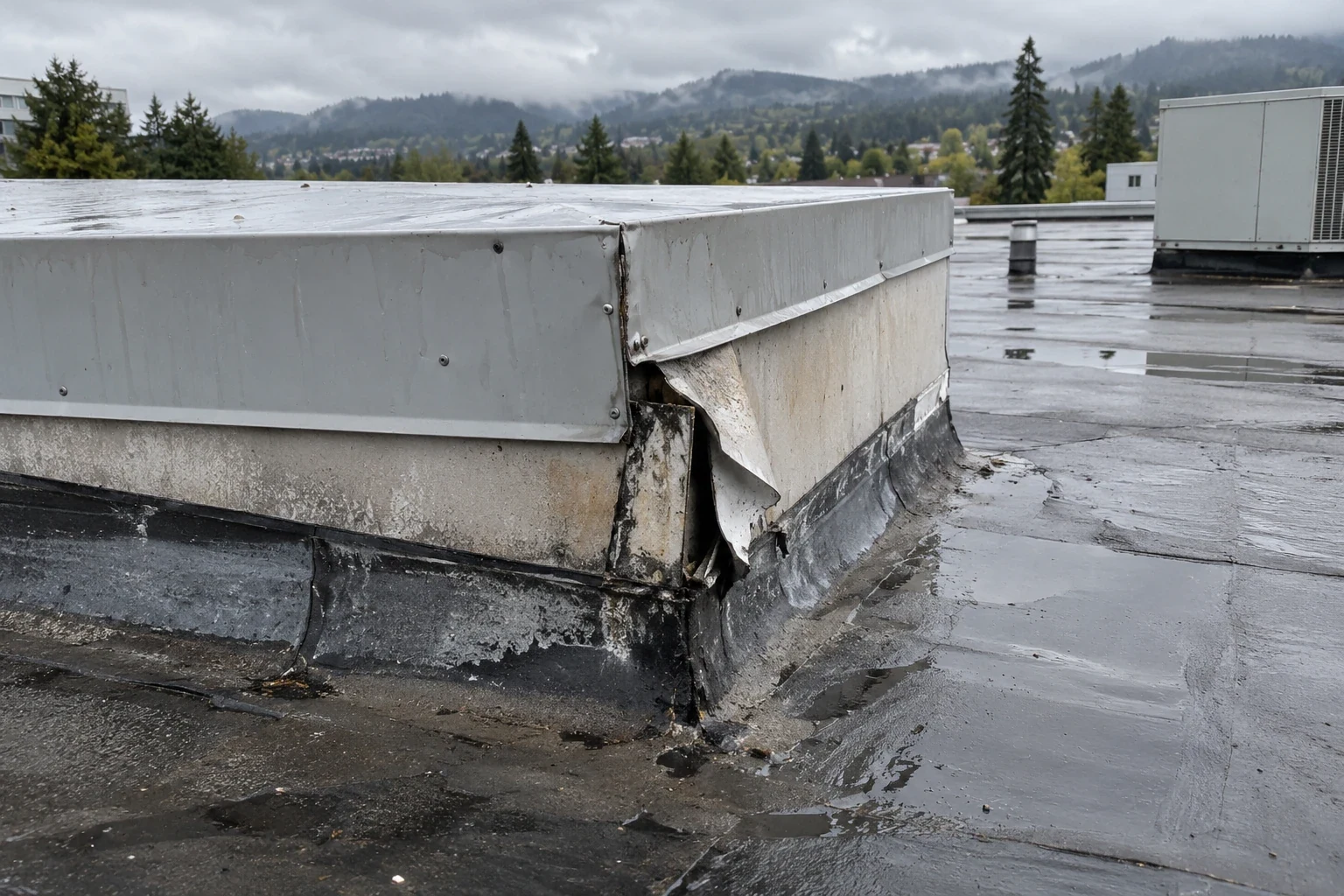
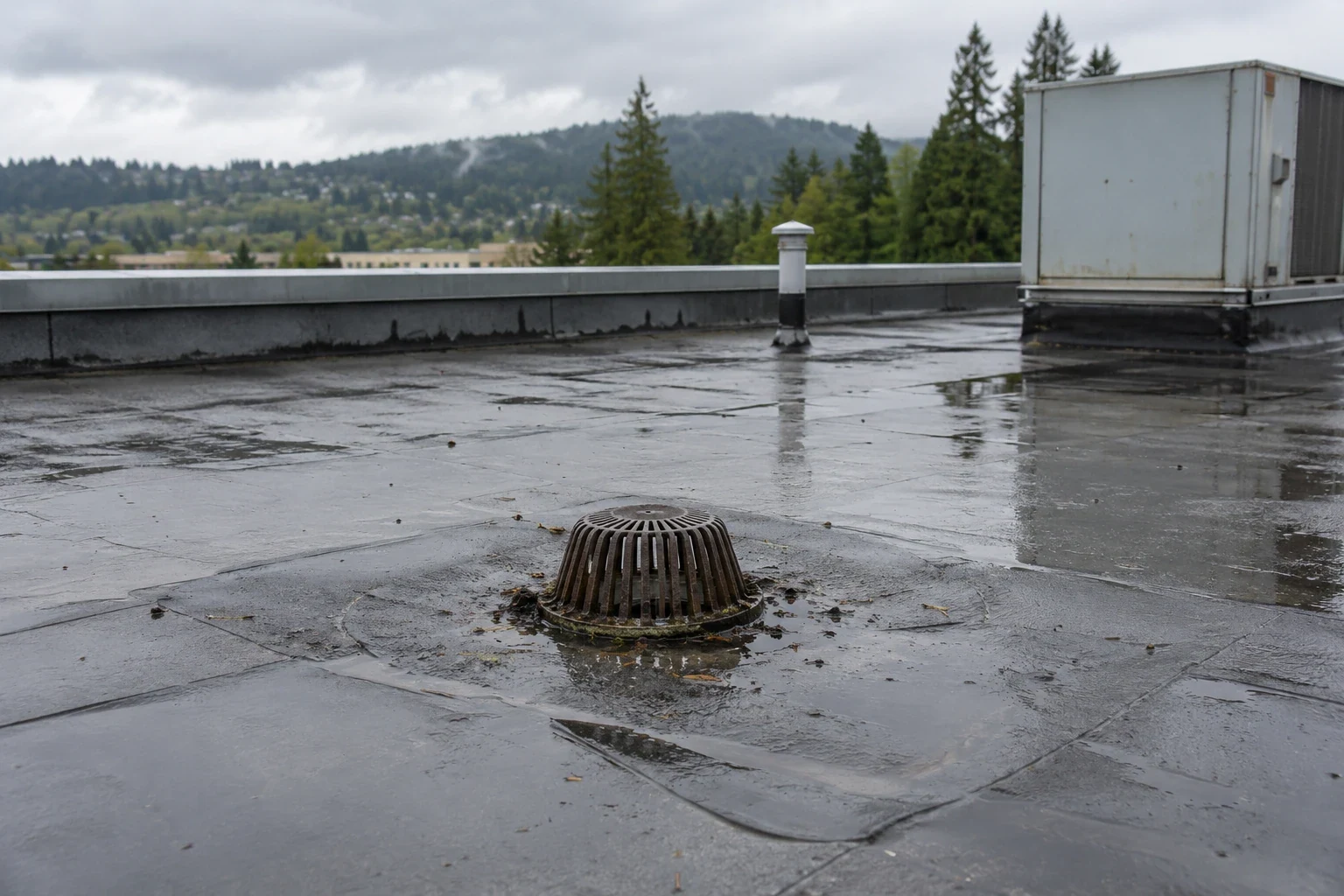
On the roof we look for the usual entries. Open laps. Cracked boots. A failed termination bar. A clogged scupper. A drain bowl with no clamping ring. Every candidate gets a moisture reading, a probe check and, where dry weather allows, a controlled hose test run section by section. We start low and move upslope, so the first section that produces a drip is the entry.
Where leaks hide
Leaks seldom sit in open field membrane. They collect at details, and the details have a pattern. Penetrations leak when the boot cracks or the clamp loosens. Walls leak when the counterflashing has pulled out of the reglet. Failed flashing is the first suspect on a wall or curb, and a seam is the next one in the field.
Drainage is the third suspect. A scupper that is a half inch too high holds water against the wall. A drain with debris backs up over the base flashing. In Bellingham, snow arrives mostly December through February, in modest amounts, and its melt sends a rush to those same drains and scuppers. A drain and scupper check belongs in every trace after a cold snap.
What the insulation tells us
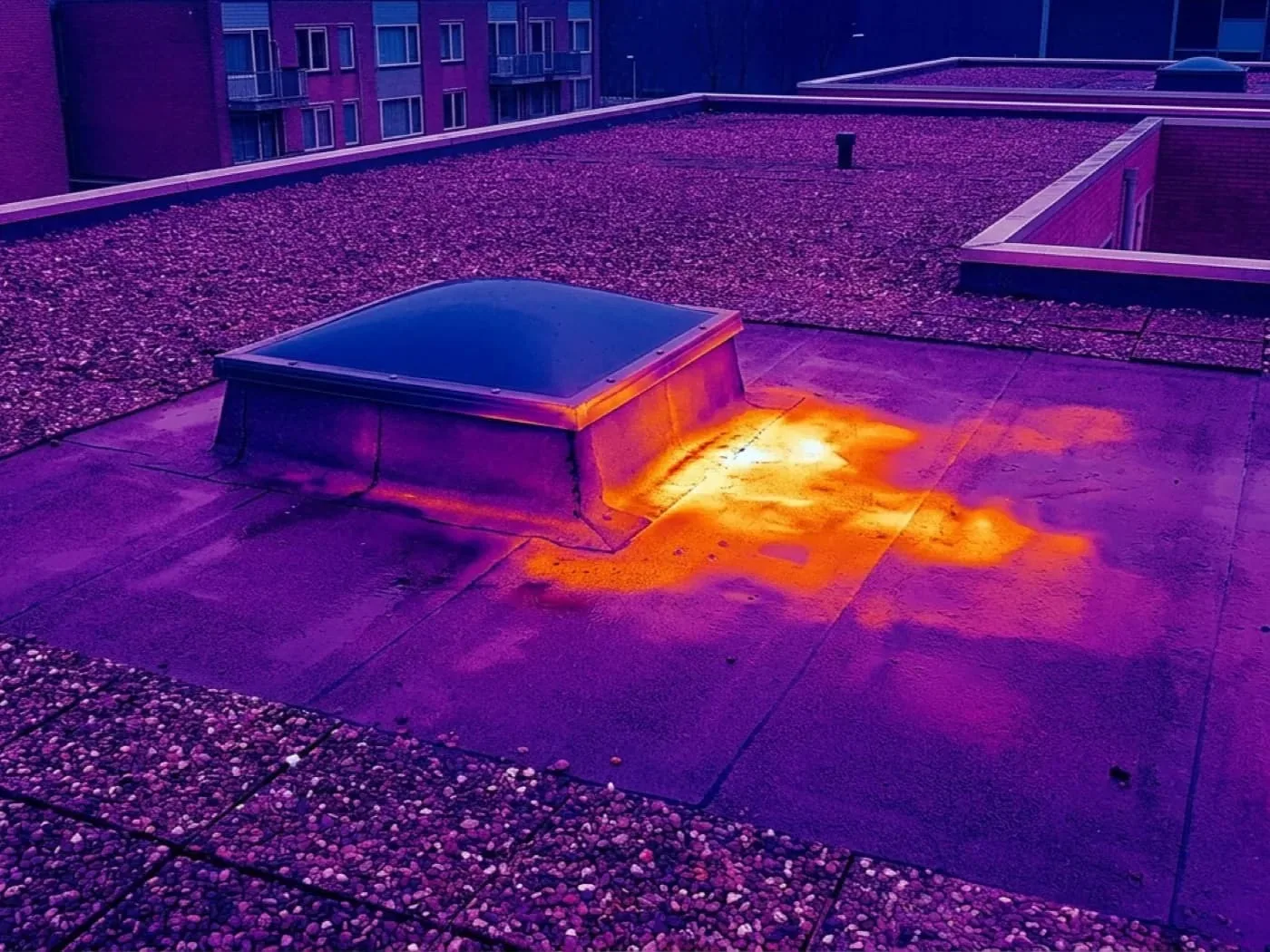
Finding the entry does not finish the job. Water that has run into the insulation stays there, and Bellingham sunshine is low, about 1,866 hours a year, so the board dries slowly. We scan the area around the leak with a moisture meter, and where the reading calls for it, with an infrared moisture survey.
That survey tells us how much roof was affected. A small damp patch gets cut out and replaced with dry board. A larger saturated area changes the scope, and the bid line grows accordingly. We show the extent on a marked plan, so the building manager sees why the repair covers more than the stain does. Skipping this step leaves a repaired entry above a damp, failing assembly.
Wet board also changes the temporary stop. We do not seal over saturated insulation and call it done. We mark the extent, note the reading beside each cut and give the manager the dates. If the area is large, the next step is a planned strip and replacement of that section, and the dry window for it goes on the calendar before the next heavy rain begins.
Stop it today, fix it right later
A temporary stop buys dry days. It might be a sealant bed, a patch, a temporary boot or a tarp held down to the deck. It is meant to last through the next rain, not the next five years. We tell the owner what the stop is, how long it should hold and when the permanent repair should follow.
The permanent repair is scheduled for a dry window, and in this climate that can mean waiting. July is the driest month, November the wettest, and the shoulder months fall in between. Seams and flashings need a clean, dry surface, and a repair done in rain peels off at the first freeze. We hold the repair for a few good days, and we say so in plain terms. If the leak is over finished space, the emergency response comes first, and the trace follows once the building is dry.
Roof types around town
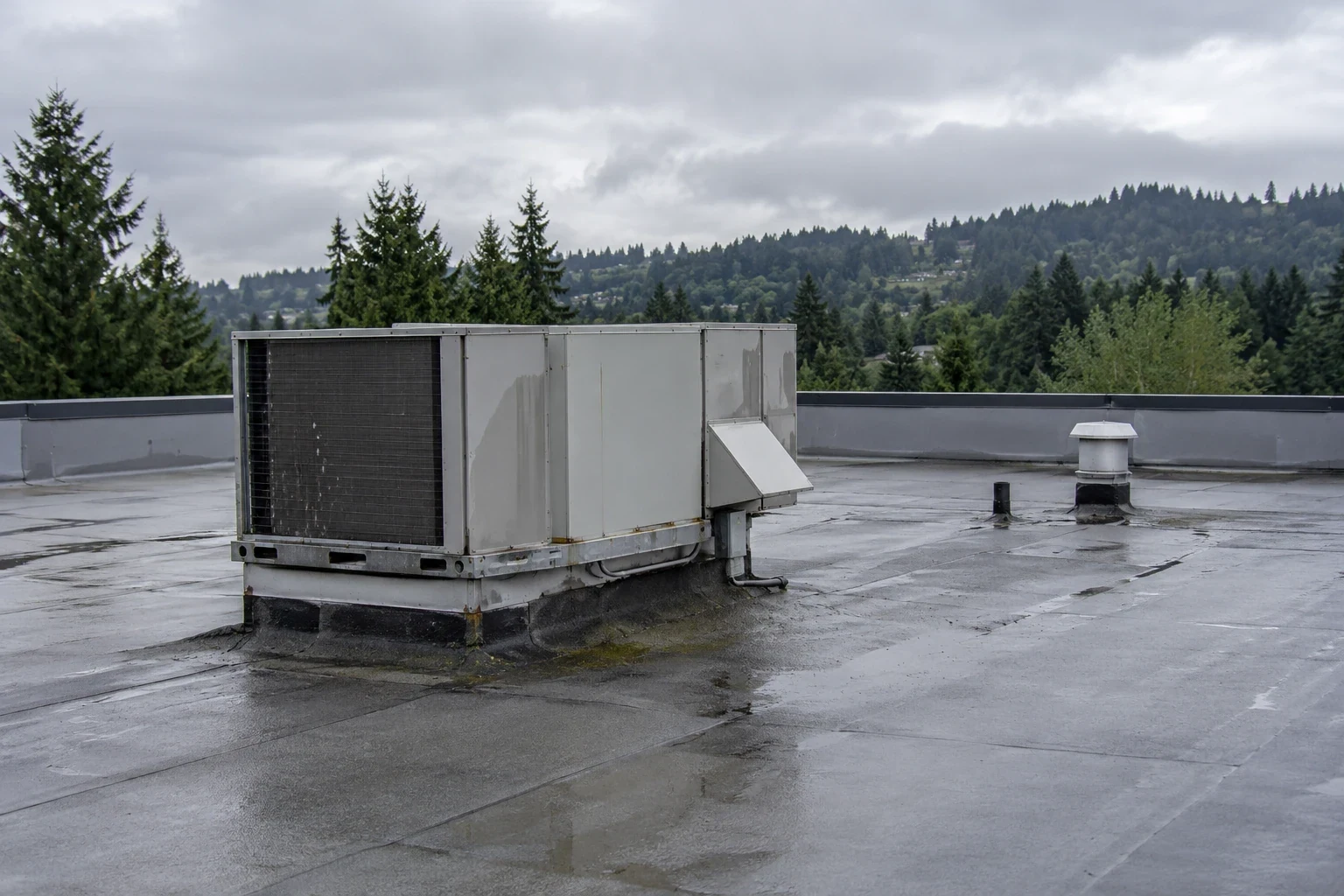
Leak behavior changes with the building. On the north side, Cordata sits near the Guide Meridian and I-5 and carries the city's northern retail and office growth. Any low-slope office building roof with rooftop equipment has a boot, a curb or a conduit penetration at each unit. Each one is a possible entry, and we check them in a set order.
Healthcare is another large user of commercial roofs in Bellingham, led by PeaceHealth St. Joseph Medical Center. On a medical building, a leak over a clinical room is a different class of problem than one over a storage room. We ask which rooms sit under the trace area before we begin, and we protect those first. Downtown, the former Georgia-Pacific waterfront is being redeveloped as a mixed-use neighborhood. A newer roof has fresh seams and little history, so we start at the details. An older roof gets the moisture scan first, because age works against the insulation.
Records and claims
Document the leak from the first call. We photograph the interior damage, the roof entry and the temporary stop, and we date each image. Those records support a claim for storm or sudden damage and show a clear cause when the loss is gradual.
The distinction matters. Insurers treat wear differently from a sudden event, and a clear trace report speaks to cause. We state what we found, where, and what condition it was in, without guessing at the policy. Photos of the roof entry, the interior damage and the first moisture reading give the adjuster a timeline from the day the call came in. The owner or adjuster decides coverage. We supply the evidence, the repair scope and the price.
Commercial Roofing Questions
Why does the leak show up far from where you find the entry?
Water runs along the deck, the insulation seams and the steel before it drops. The exit point can sit many feet from the entry. We read the interior map against the roof slope and trace upslope, then confirm with a test at the suspected spot.
Can you trace a leak during rain?
We can do part of it. Rain shows active entries, and we can read moisture and look at drains and seams. A controlled hose test needs dry weather so we know the source. If the roof cannot be tested safely, we place a temporary stop and finish the trace on the next dry day.
What if the leak returns after the repair?
A return usually means a second entry or wet insulation spreading under the membrane. We recheck the moisture readings and the test sections against the original map. Both findings go into a revised scope, with the cost of any added work shown as its own line.
How much of the roof will you open to find it?
As little as the evidence allows. Most traces need no cuts at all. Where a core cut confirms wet insulation, we cut a small sample, read it, and patch it the same day. Larger openings only happen once the readings justify them.
Does a leak mean the whole roof is failing?
Not necessarily. One bad detail on a sound sheet is a repair. Repeated leaks across the field, a brittle membrane or saturated insulation over a wide area point toward planned repair or replacement. The trace report separates the two cases.
Call with the stain location and the room below
Tell us where the water shows and what sits beneath it. We will map the interior, trace the roof and price the stop and the permanent repair on separate lines.