Office Building Roofing in Bellingham, WA
Office building roof repair, recover and replacement in Bellingham, WA, scheduled around tenants, rooftop units and the short dry season.
Office Building Roofing in Bellingham, WA
Office building roof repair, recover and replacement in Bellingham, WA, scheduled around tenants, rooftop units and the short dry season.
Property Types We Roof
Office Building Roofing in Bellingham
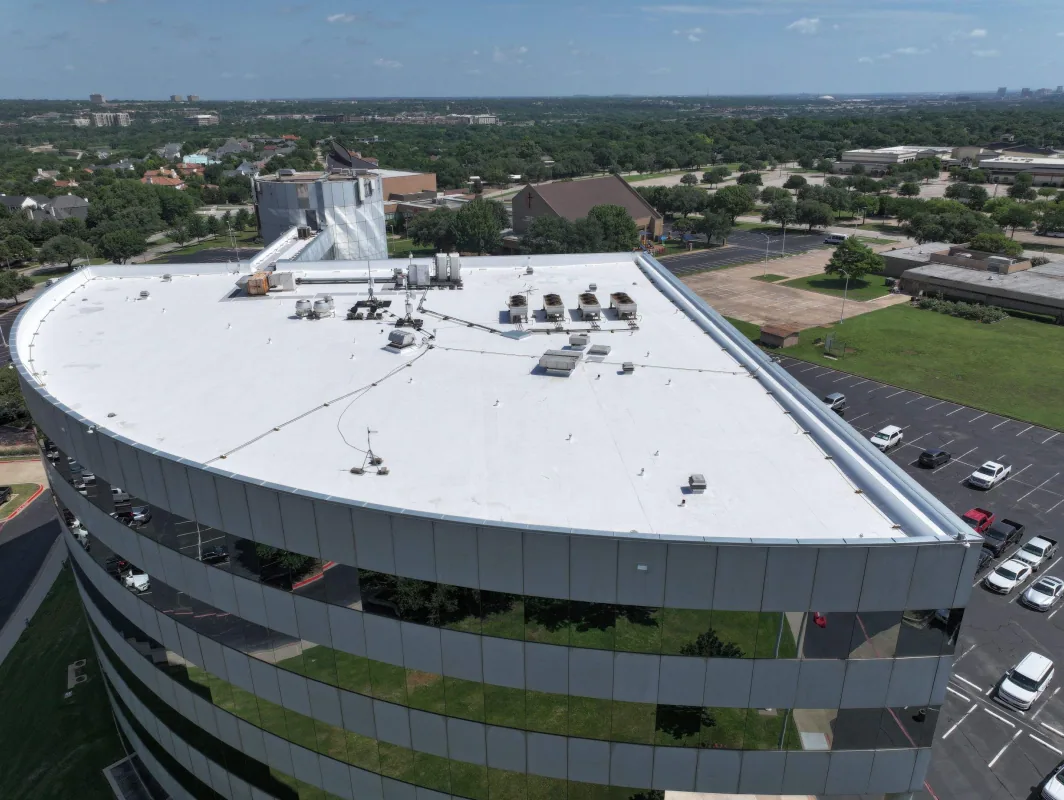
Every new rooftop unit starts as a hole in the roof. Tenant improvement crews cut it, set the curb and leave. The roofer finds out at the next leak. On an office building in Bellingham, WA, that pattern is a common source of leaks. A roof with six units has six chances to leak.
We start with the penetrations. Then we look at the field. Send the drawings, the tenant list and a dry-in date, and every curb and termination gets a price before the bid closes.
Overview
Office Building Roofing
Units, curbs and sealant
Office roofs fill up over time. A building can open with two units. Tenants then add more. Each addition brings a curb, a conduit and a gas line. Each one gets flashed by whoever was on the job that week.
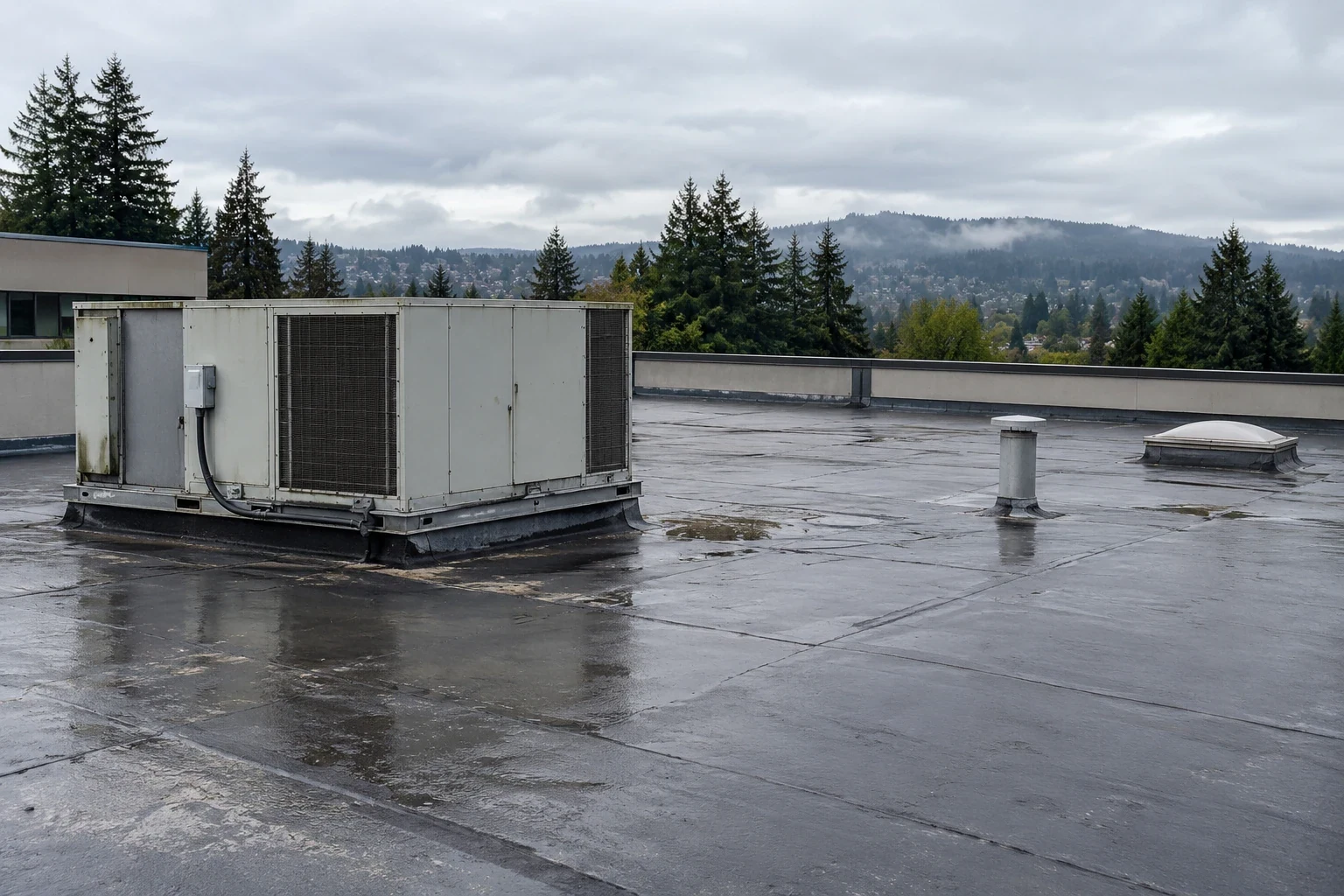
On a first walk we count every penetration and rate its flashing. We check curb height, sealant condition and membrane laps. Curbs that sit too low get raised. Sealant that has cracked gets replaced. The curb and support work becomes a bid line. The owner sees what the penetrations cost apart from the field.
A good roof file lists each unit, its age and its flashing date. Future tenant work can then follow the file. That keeps new holes from becoming new leaks.
Unit swaps are the moment to act. When a mechanical contractor pulls an old unit, the curb is open to inspection. We ask to be there. A rotted nailer, a split flashing or a low curb can be fixed in an hour while the unit is off. Fixing it after the new unit is set means cranes and a second visit. We put the swap date on the roof calendar and send a crew for that day.
Tenants above, tenants below
Office tenants notice noise, smell and dust. A tear-off over an occupied suite brings all three. The property manager hears about it first. We plan to keep that call from happening.
Noisy work goes to early hours, before suites fill. Hot work stays off the roof where air intakes sit below. Material staging stays away from entrances and parking. We post notices a week ahead and again the evening before. These steps follow the occupied building reroofing method, and each is a line on the bid.
Phasing protects ceilings. We open a section, dry it in and close it the same day. A leak watch stays staffed inside until the section is sealed.
Air intakes need attention. Roofing fumes and dust can reach a ventilation intake if the unit is downwind. We shut or cover intakes only with the mechanical contractor's sign-off. Solvent-free, cold-applied adhesives and heat-welded seams cut odor. The bid shows the product choice so the property manager can answer a tenant who asks.
Where office roofs sit here
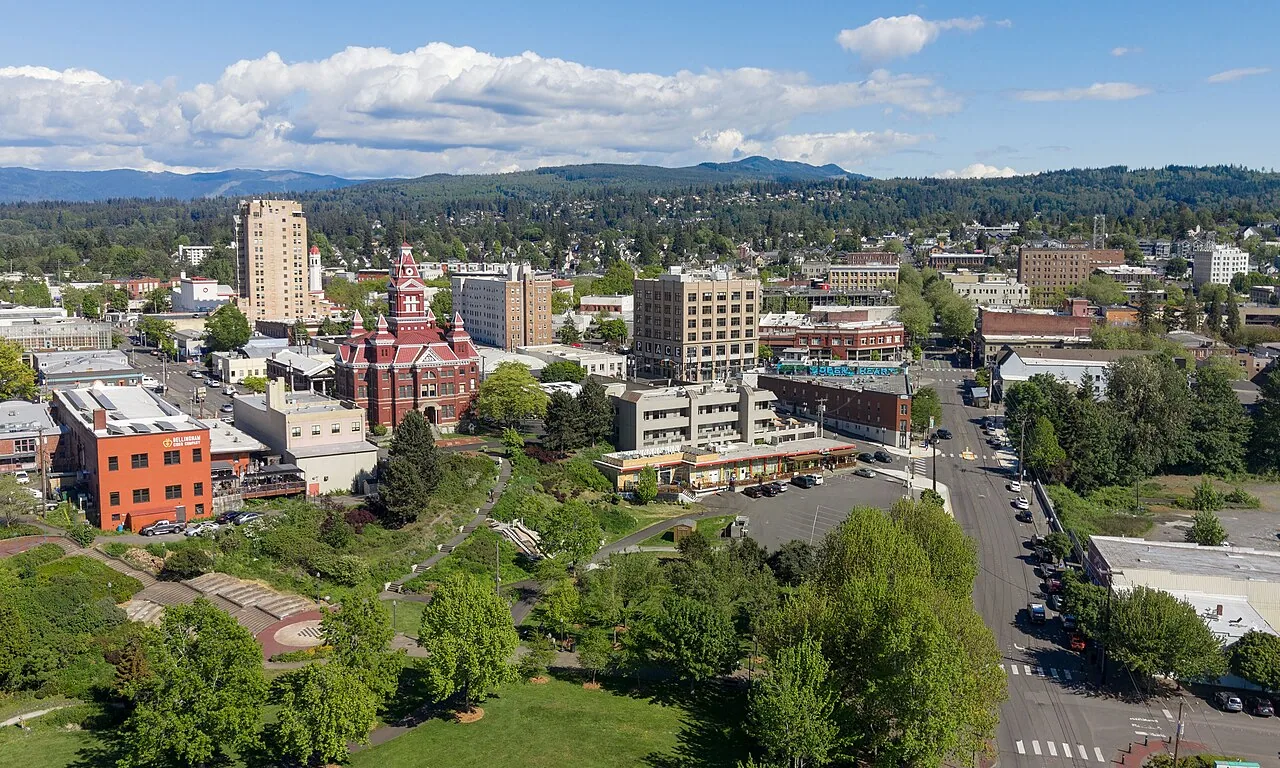
Downtown is the central business district of the county seat. Cordata, north of downtown, holds the city's northern retail and office growth near Whatcom Community College. The former Georgia-Pacific pulp mill waterfront is being redeveloped as a mixed-use neighborhood, with 19 acres under Harcourt Developments.
Each area asks something different. Downtown Bellingham asks about tight streets and staging. Cordata asks about its north-side retail and office roofs. Waterfront redevelopment asks about new construction schedules and the trades that share them. The first walk answers the roof type.
What moves the number
Five items move an office roof price. They are penetrations, insulation, tear-off depth, access and phasing. Insulation depth now follows the state energy code that took hold on March 15, 2024, and each extra inch raises the flashing at every unit. A thicker board lifts the flashing and raises the material line. Tear-off depth depends on the number of existing layers. Access depends on the street. A tight downtown block needs crane permits and traffic control. Phasing depends on tenants. Each tenant adds a constraint, and each constraint costs a little.
A TPO or other single-ply recover can skip the tear-off on a dry roof. The savings are real. The moisture readings decide whether it qualifies.
Downtown work carries an extra item. A crane or lift on a city street needs a permit, a traffic plan and often a flagger. Those costs land on the bid as their own line. A building with a rear alley or a side lot avoids most of them. We walk the site to see which case applies before we price.
Plan for the dry months
Rain totals about 34.8 inches a year in Bellingham, and tenants notice every inch that finds a ceiling. November is the wettest month and July is the driest, so tenant-friendly work lands in summer. Low sun, about 1,866 hours a year, means a deck dries late in the day. Open only what the crew can close. A lost morning can become a lost day. We want terminations and metal closed before the fall rain returns.
Lease dates matter too. A reroof timed to a lease renewal lets the owner show a new roof. A reroof timed to a lease expiry avoids disturbing a tenant who is about to leave. We ask for the lease calendar early.
Holiday weeks and tenant moves also fall in the calendar. We avoid year-end close and move-in weekends when the owner asks. Each avoided week is a day the roof stays open longer. The schedule shows the tradeoff so the owner can choose.
Wind and the edge
A 67 mph gust in March 2016 pulled stucco off a Bellingham storefront, and an office parapet takes wind from the same direction. In November 2024 a bomb cyclone swept easterly wind through Sudden Valley and rattled loose screens. Office roofs have parapets, copings and mechanical screens. All of them catch wind.
We specify perimeter fastening on every bid. Seams get probed and caps get pull-tested before the owner signs. Screens and louvers get a fastener check as well. The owner or the property manager closes the punch walk. Open items get a date. A roof condition report follows, with photos and a map. A medical office suite or a hospital wing adds infection-control rules on top of the same detail.
Parapet height and base flashing height get measured, not eyeballed. A low base flashing is a leak path and a code issue. Raising it adds wall work and a trade. We price that as its own line so the cost does not hide.
Commercial Roofing Questions
How do you protect tenants during a reroof?
We set early hours for loud work, stage materials away from entrances and keep a leak watch inside every open section. Notices go out a week ahead.
Who owns the flashing when a tenant adds a unit?
The roof file does. We log each new penetration with a date and a detail. Future crews follow it, and the warranty stays intact.
Can an office roof be recovered instead of replaced?
Often, when core cuts show a dry assembly and the deck can carry the added weight. We price the recover and the replacement side by side.
What is the best time to schedule an office reroof?
Late spring through early fall. The dry window is wider, and the lease calendar usually has room. We confirm both before the bid.
What does the property manager receive at closeout?
A roof map, photos by area, a penetration log and the punch list sign-off. The warranty paperwork follows once the list is empty.
What does a roof file for an office building contain?
Contents run from the roof plan to the penetration count, flashing dates, moisture readings and photos by area. It also lists every warranty condition, so future tenant work does not void coverage. Each entry carries a date and a name.
Send the drawings and the lease calendar
Send the roof plan, the spec and your target dry-in window. We will price every curb, termination and phase before the bid closes.