Modified Bitumen Roofing in Bellingham, WA
SBS and APP modified bitumen roofing in Bellingham, WA: torch, cold-applied and self-adhered options, laid in layers for foot traffic and long wet seasons.
Modified Bitumen Roofing in Bellingham, WA
SBS and APP modified bitumen roofing in Bellingham, WA: torch, cold-applied and self-adhered options, laid in layers for foot traffic and long wet seasons.
Roof Systems
Modified Bitumen Roofing in Bellingham
Two layers of asphalt, one cap sheet and a lot of lap lines. That is a modified bitumen roof, and every lap is a place where water gets a vote. In Bellingham, WA, where November runs wet and a deck dries slowly, we count those laps before we count squares. The count tells us how many days the crew needs and how many mornings the weather can take.
Modified bitumen is asphalt blended with polymer, either SBS rubber or APP plastic, and reinforced with fabric. It arrives in rolls, goes down in two or three layers and finishes with a granulated or coated cap sheet. It is tough, repairable and familiar to every inspector. Its weakness is the field labor, which is slower and more weather-sensitive than a single-ply sheet.
Overview
Modified Bitumen Roofing
SBS and APP
SBS stands for styrene-butadiene-styrene, a rubber polymer. SBS sheets stay flexible in cold and stretch with building movement. They are the common choice in climates with cold snaps, and Bellingham gets occasional ones in December through February.
APP stands for atactic polypropylene, a plastic polymer. APP sheets resist heat and UV well and are usually torch-applied. They are stiffer in cold, though Bellingham rarely gets cold enough to matter.
The choice often comes down to the install method and the building. SBS can be laid in hot asphalt, with cold adhesive or with torch. APP is almost always torched. We choose with the owner after reading the roof plan, the fire rules and what sits close to the roof edge.
Torch, cold-applied or self-adhered
Torch application melts the underside of the roll and presses it into place. It is fast and gives a strong bond. It also needs a fire watch, careful use near combustible walls and a steady hand at details. Many owners and insurers limit torch work near occupied space.
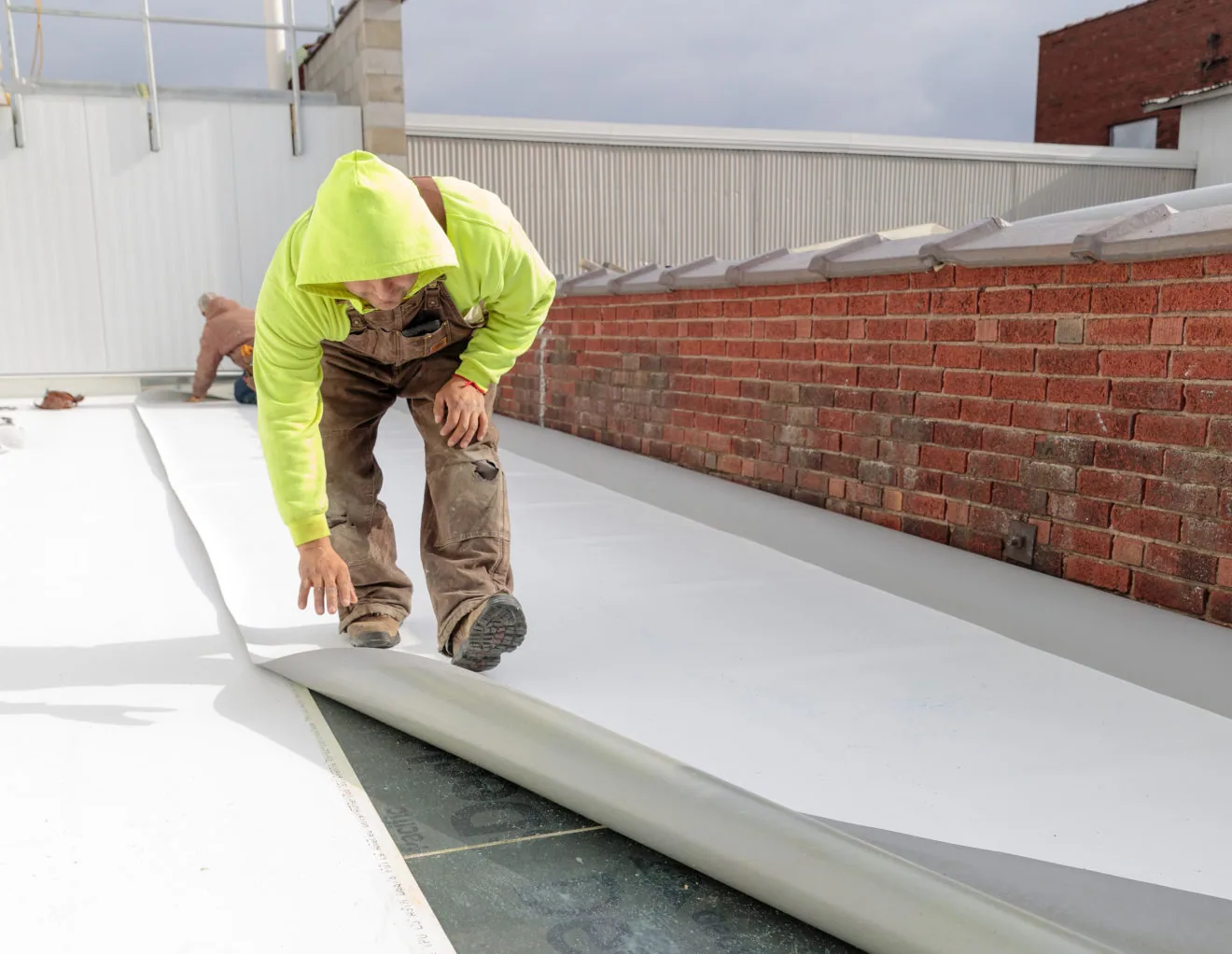
Cold-applied adhesive avoids the flame. Rolls are set in a compatible adhesive, and the bond cures over hours. It is slower, and a damp morning ruins the bond. Self-adhered sheets peel and stick, with no heat and no adhesive pour, but they need a primed, dry substrate.
On Bellingham schedules, the cold methods add risk from rain and dew, while torch work adds fire-watch time. We state the method on the bid, with the fire plan and the weather limits next to it.
Substrate prep is common to all three. A cover board or a fresh base sheet goes over the insulation, and every fastener is checked for backing out. Old roofs show lifted heads along the deck flutes, and each one gets pulled or reset. That pass takes crew time that the bid should carry.
Plies, laps and the cap
A typical build uses a base sheet, an interply and a cap. Each layer is offset from the one below, so no lap line stacks on another. That staggering is why modified bitumen is forgiving of small defects.
The cap carries the weather. Granules protect the asphalt from UV and give color. In a low-sun market the UV load is lower, though granule loss still shows at drains and ponding areas, where the asphalt is exposed.
End laps and side laps need clean, tight edges and a bead of melted asphalt at the seam. We check by eye and with a trowel pass, then run a probe along the cap laps. Any lift is re-sealed the same visit.
Foot traffic tolerance is the reason many owners keep choosing it. A rooftop with heavy mechanical visits benefits from the added thickness of a multi-ply build.
Weight is worth a word. Three plies of mineral-surfaced sheet weigh more than a single-ply, and an older structure may have little spare capacity. We ask for the structural notes before we quote a three-ply build over a deck that has already carried one.
Flashing and edges
Modified bitumen flashing is built in the same layers as the field. A base flashing runs up the wall, a cap flashing covers it and a termination bar or counterflashing seals the top. Heights follow the spec, and the roof deck slope can change them.
Edge metal matters on windy sites. Gusts hit 67 mph in March 2016, and in November 2024 a bomb cyclone pushed easterly winds through Sudden Valley. A loose edge is the first thing a gust lifts. A tested edge and coping detail is part of every bid.
Curbs and drains need extra layers. Each curb gets a stripping ply, and each drain gets a flashing ring and a reinforced collar. Those details take more time than the field, and the bid shows them as lines.
Gravel stop and fascia details are the common edge types on older buildings. Gravel stop holds the edge of the roof and a bead of mastic seals the flange. When the metal has loosened, we re-fasten it at close spacing before the new layers go on.
How it ages and how it is repaired
Modified bitumen fails at laps, flashings and ponding areas. Blisters form where moisture trapped in the system expands. Granules wear off at traffic paths, exposing the asphalt below.
Moss and algae grow on the cap in this climate, since about 1,866 hours of sun a year leaves the surface damp. The growth holds moisture against the asphalt. We clean it and check the surface underneath for softness.
Repairs are practical. Blisters are cut, dried and patched. Lifted laps are reheated or re-adhered. A coating can restore the cap over a sound roof, as with roof coating restoration. When the base layers are wet, a moisture survey maps the damage so the owner can cut out only what is wet.
Drains tell the story. Granule loss collects in the sump, and a pile of grit in the strainer means the cap is wearing. We check the sumps at every visit and record the trend, so the owner sees when the cap is nearing the end.
Where it gets specified
On older commercial buildings in downtown, Fairhaven and the Port of Bellingham industrial parks, a replacement can stay in kind, since the deck, the details and the inspectors are already set for it.
It also suits roofs with heavy equipment traffic. Where a manufacturing roof along Marine Drive or a healthcare roof near PeaceHealth St. Joseph sees steady foot traffic, a multi-ply cap tolerates it. A built-up roof follows the same layered logic with more plies of felt and hot asphalt.
Compared with TPO, modified bitumen costs more in labor, and its layered build forgives more small defects. On the Marine Drive waterfront, roofs with steady foot traffic and many details are the ones that suit it.
Commercial Roofing Questions
Is torch application still used on occupied buildings?
Often it is restricted. Insurers and owners limit open flame near occupied space, so we offer cold-applied and self-adhered options with a fire plan for any torch work. Fire watch time goes on the schedule.
What weather ruins a cold-applied install?
Rain does, and so does dew on the base sheet. Adhesive needs a clean, dry surface and time to set. In the wet season we hold the work and keep the strip small enough to close in a day.
How many layers does the roof need?
The spec and the warranty position set it, usually two or three plies. More layers add durability and foot-traffic tolerance. They also add weight, so a structural check comes first on an older building.
Can a blistered modified bitumen roof be saved?
Often yes. Blisters are cut open, dried and patched, provided the insulation below is not saturated. A moisture scan separates small patches from a roof that needs replacing.
Does modified bitumen handle ponding?
Better than some sheets, but ponding still ages the cap and loosens laps. We add tapered insulation or a drain where water stays more than a day or two.
Send the roof plan and the fire rules
Send the drawings, the roof spec and any limits on open flame. We will price the plies, the laps and each flashing as separate lines before the bid closes.