Warehouse Roofing in Bellingham, WA
Warehouse roof repair, recover and replacement in Bellingham, WA, priced by dock header, edge metal and dry-in day so general contractors can bid it clean.
Warehouse Roofing in Bellingham, WA
Warehouse roof repair, recover and replacement in Bellingham, WA, priced by dock header, edge metal and dry-in day so general contractors can bid it clean.
Property Types We Roof
Warehouse Roofing in Bellingham
A dock-door header is a small piece of metal. It can stall a warehouse reroof for a week. Bellingham, WA has a long wet season, and a header left open in October stays open until the next dry stretch. We look at the headers first. Then we look at the field. The headers set the calendar, and the calendar sets the bid.
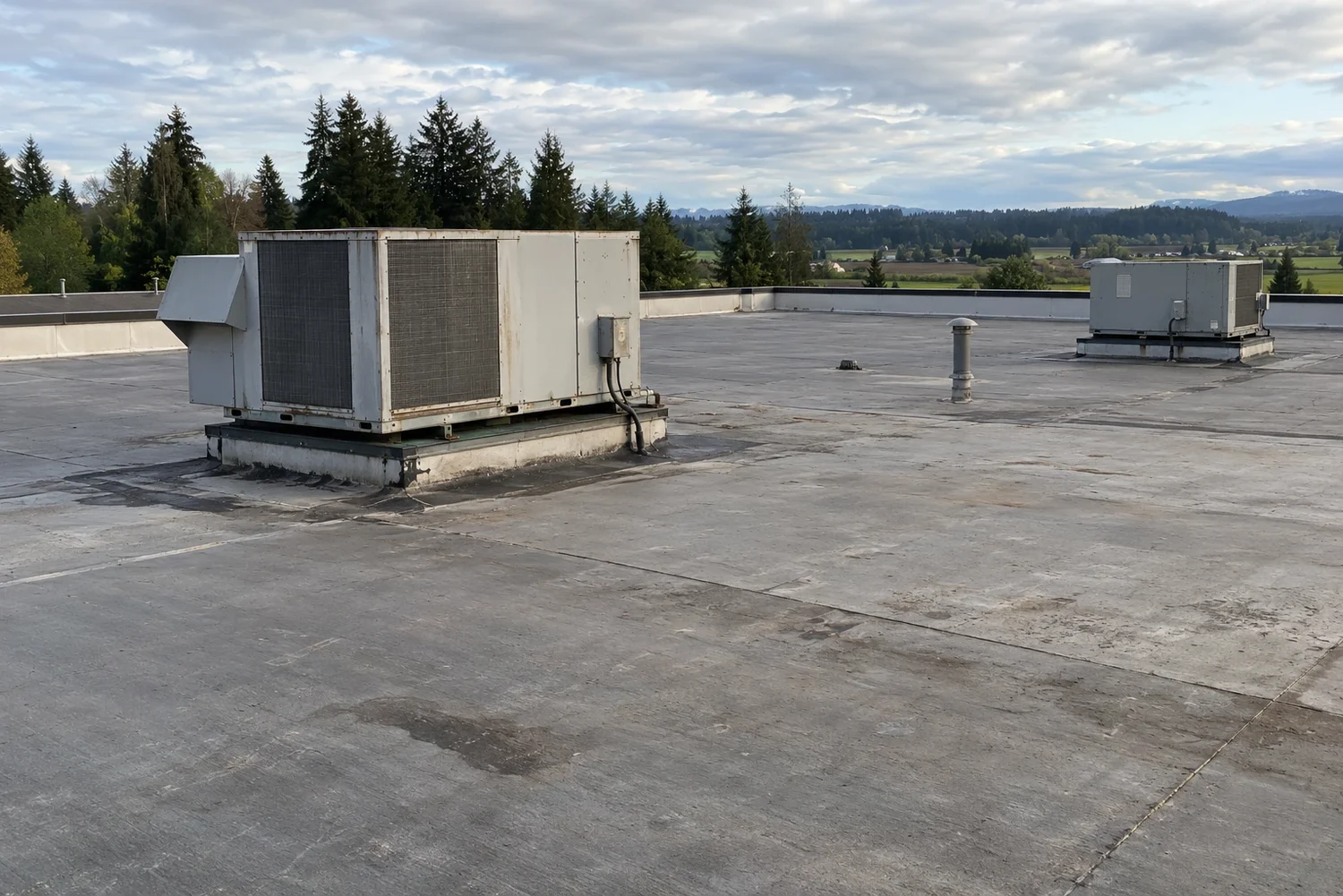
Warehouse roofs are large, flat and mostly empty. That makes them look simple. They are not. The cost sits in the perimeter, the penetrations and the drains. Send us the drawings and the target dry-in window. We will price every termination before the bid closes.
Overview
Warehouse Roofing
The header and the parapet
Most warehouse leaks start at an edge. Dock headers, parapet caps and wall tie-ins take the first hit. Metal moves with temperature. Sealant ages. A coping cap that lifts a quarter inch lets rain behind the membrane. Rain behind the membrane runs along the deck until it finds a seam.
On a first visit we check base flashing height, counterflashing laps and cap fastening. We note every spot where metal meets membrane. That list becomes a bid line. The owner sees what the edges cost apart from the field. A general contractor can then compare the number against the schedule.
Where the existing parapet is low, we say so. A low base flashing is a code and a leak problem. Raising it adds wall work. Wall work adds a trade to the sequence. We price it as its own line.
What drives the number
Four items move a warehouse roof price. They are deck condition, insulation thickness, perimeter length and access. The membrane is the smaller number on most bids.
Nobody can read the deck until the old roof comes off, so the bid holds an allowance and a unit rate for steel deck repair. The 2021 Washington State Energy Code sets insulation thickness here, and it has applied statewide since March 15, 2024. Thicker board raises the material line and lifts the flashing heights. Perimeter length sets the metal bill. A long building has a long edge. Access sets crane time and haul-off trips.
Interstate 5 is the main freight corridor through Bellingham, and the Port of Bellingham runs several industrial parks in and around the city. Staging room differs lot by lot. We confirm where the lift stands and where the trucks turn before we price.
Why summer matters
November is Bellingham's wettest month. July is the driest. The city gets about 34.8 inches of rain a year and roughly 1,866 hours of sun. A damp deck dries slowly in that light. A lost morning can become a lost dry-in day.
Large roofs need large dry windows. A crew strips only what it can close before dark. On a big warehouse that means phased areas and a tight material flow. We want terminations and metal closed before the fall rain settles in. Starting in late spring leaves room for a rain delay and still finishes ahead of November.
If the owner cannot start until fall, we price a phased scope. Dry-in comes first. Detail work follows on the next clear day. The bid shows which days carry risk.
Wind and the perimeter
Bellingham's March 2016 gusts reached 67 mph and stripped stucco off a storefront. A bomb cyclone in November 2024 drove easterly winds across Sudden Valley and the east side of town. Warehouse roofs are big sails. Their edges take the load.
Perimeter fastening goes on every bid. We specify the fastener spacing and the edge metal gauge. We probe the edge seams after install. A cap that passes a pull test in July passes in a November gale. A cap that was set fast on a wet morning may not.
Near the water, wind comes with salt and moisture. Fasteners and sealants get a closer look on the Marine Drive waterfront. The Airport Industrial Area gets the same perimeter check.
Racking below, crew above
Most warehouses keep running during a reroof. Product sits on racking directly under the deck. A drip over a pallet is a claim. We plan for that before the first panel comes off.
Phasing protects the floor. We open a section, dry it in the same day and move on. Interior leak watches stay staffed until the section is closed. Noise and fastener drop zones are agreed with the operator. Forklift lanes and dock doors keep their hours. The bid shows each phase and each interior protection item as its own line. Nothing hides in a lump sum.
Drains and scuppers
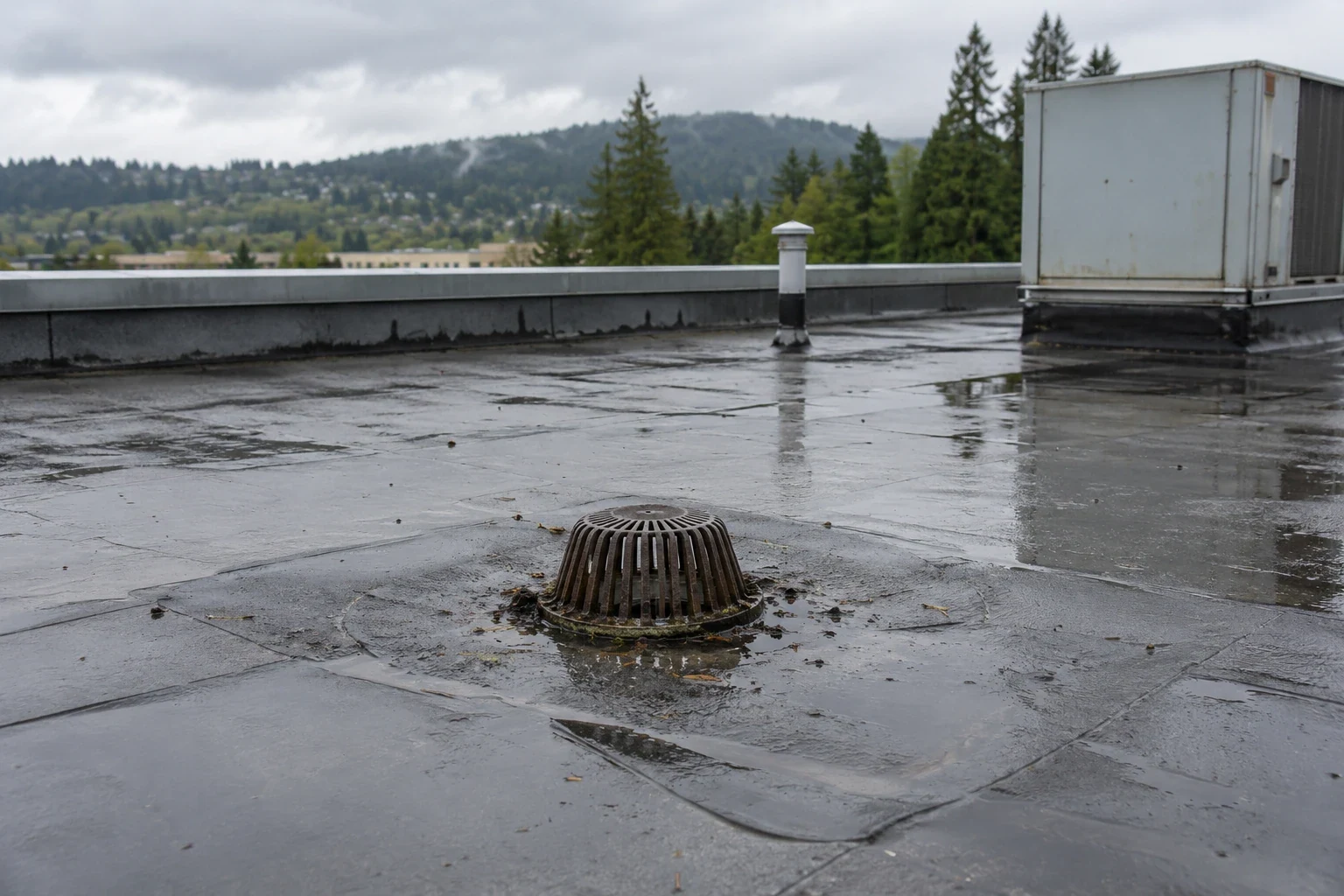
A flat roof is only flat on paper. Ponding starts where the deck sags or a drain sits high. Standing water adds weight and speeds aging. It also feeds moss, and Bellingham's low sunshine keeps moss alive on shaded membranes.
We check every drain and scupper on the first walk. We look at sump depth, strainer condition and overflow height. A scupper set an inch too high holds an inch of water across the field. Fixing it can be a cheap line or a roofing-plus-masonry line. We say which before the bid.
Crickets matter where water cannot reach a drain. A cricket behind a rooftop unit costs little. It prevents a pond that could void a warranty. Crickets go on the plan as separate items.
Sequence and punch
Roofing sits between trades. Mechanical sets curbs. Electrical runs conduit. The sprinkler contractor may need roof access. Each trade adds penetrations and foot traffic. We schedule the roofing so the membrane is not torn after it is finished.
The punch walk closes the job. We walk the roof with the owner or the general contractor. We check seams with a probe, caps with a pull test and drains with water. Anything open gets a date. The warranty paperwork follows the punch walk, not the other way around. An infrared moisture survey after install is a good baseline for later claims.
On system choice, TPO is a common warehouse sheet, mechanically attached or adhered, because it welds fast and reflects heat. Other single-ply and metal options exist. The right one depends on the deck, the budget and the hold period. A distribution center or flex industrial building follows the same logic.
Commercial Roofing Questions
How big can a phase be on a large warehouse roof?
Size follows the crew and the forecast. We strip only what we can close that day. A phase map goes on the bid so the calendar is visible.
What pushes a warehouse reroof past the dry season?
Late permits, long metal lead times and deck repair that was larger than the allowance. Any of the three can push the start into October. We flag the metal order date on the schedule.
Should a warehouse get a recover or a full replacement?
The moisture readings decide. A dry assembly can take a recover. A saturated one cannot. We take readings before we price either option.
Does the energy code change warehouse insulation?
Yes. The 2021 Washington State Energy Code applies to a new roof assembly. Thickness and R-value requirements change the material line and the flashing height.
Who owns the punch list?
We write it with the general contractor. Each item gets a name, a date and a sign-off. The closeout packet waits until the list is empty.
What does the operator need to do before a tear-off?
Move product away from the open section and give us a dock-door schedule. We confirm both at the pre-start walk and again the morning of each phase.
Send the drawings and the dry-in window
Send the roof plan, the spec and your target dry-in window. We will price every termination, metal line and deck allowance before the bid closes.