Big-Box Retail Roofing in Bellingham, WA
Roof recover, repair and replacement for big-box retail in Bellingham, WA, phased over live sales floors with drain runs and holiday dates priced up front.
Big-Box Retail Roofing in Bellingham, WA
Roof recover, repair and replacement for big-box retail in Bellingham, WA, phased over live sales floors with drain runs and holiday dates priced up front.
Property Types We Roof
Big-Box Retail Roofing in Bellingham
A big-box store has one roof, one tenant and a very long drain run. Water on a flat roof that size travels a long way before it finds a sump. In Bellingham, WA, where November rain can run for days, a single clogged drain can turn into a pond the size of a parking bay. We start there.
Big-box retail runs on corporate calendars. Holiday freezes, remodel cycles and vendor rules set the roof window. Send us the drawings, the store's blackout dates and the target dry-in window. We will mark each drain, curb and termination before the bid closes.
Overview
Big-Box Retail Roofing
The long drain run
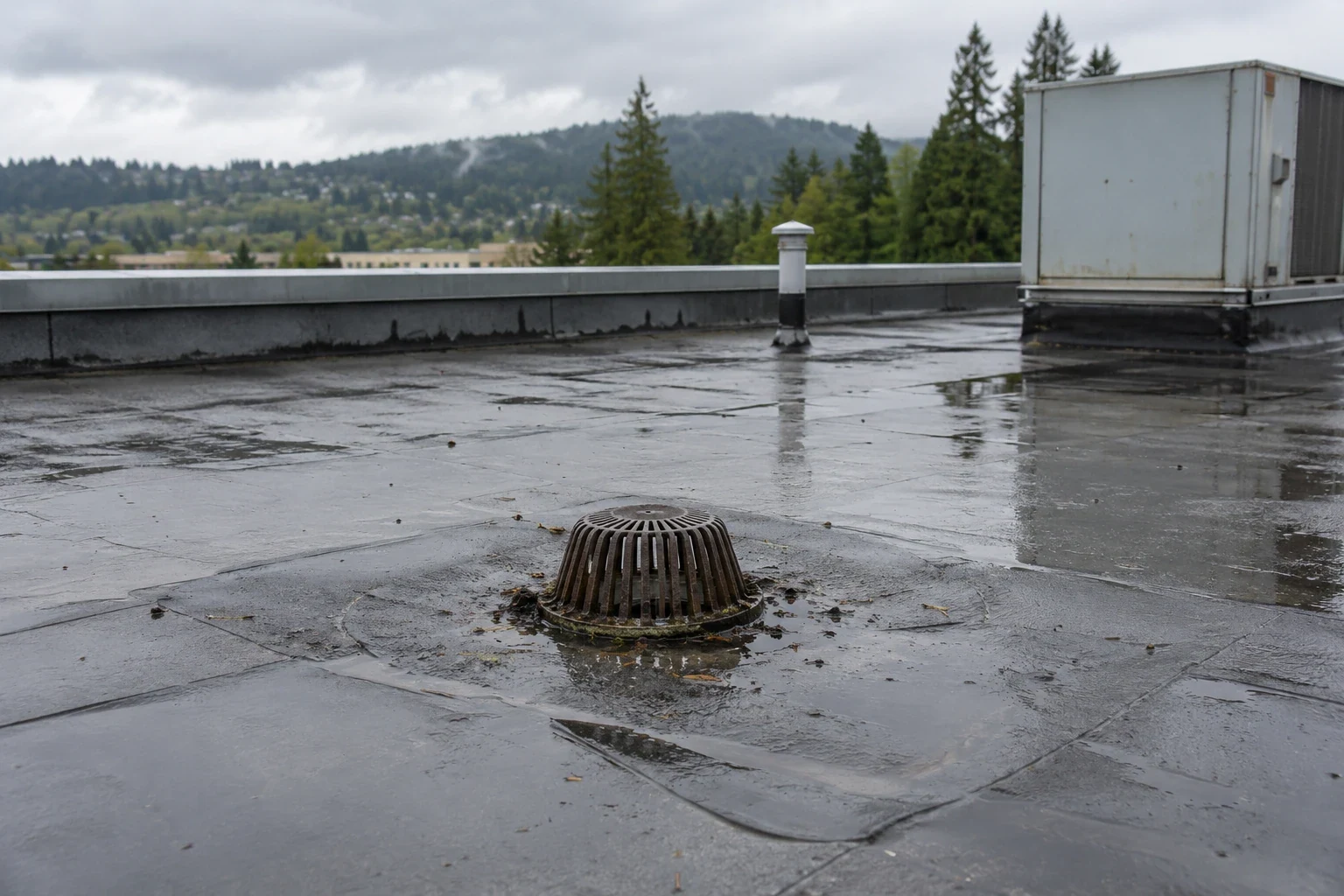
A wide roof needs many drains, and every one has to work. Interior drains run through the store on pipes that nobody sees. A sump set an inch high holds an inch of water across the field. A strainer packed with moss and needles does the same.
On the first walk we map every drain and scupper. We check sump depth, strainer condition and overflow height. We pour water and watch it travel. Ponding after rain marks low spots. We measure depth and trace each pond to a cause: sag, a high drain or a missing cricket.
Standing water adds weight, speeds aging and feeds moss. Bellingham's low sunshine, about 1,866 hours a year, keeps moss alive on shaded membranes. A drain and scupper fix is often the cheapest line on the bid and the most valuable.
Crickets and tapered insulation fix slope where the deck cannot. A cricket behind a unit sends water to a drain. It costs little and prevents a pond that could argue with a warranty.
Big boxes on the interstate
The Bellis Fair interchange, where I-5 meets SR 539, is ringed by big-box tenants including Target, Kohl's, Dick's and Ashley Furniture. SR 539, the Guide Meridian, links Bellingham to Lynden and the border. This is the city's main northern retail zone, and big-box roofs are wide by design.
The location shapes the work. Crane placement, truck routes and open-lot wind all get checked on site. Work along the Guide Meridian corridor and in Birchwood follows this pattern. We confirm each site on the first walk, since no address tells us what the roof is made.
Records matter on big roofs. A store that files a roof map, a moisture baseline and a penetration log can answer a landlord, a lender or an insurer in a day. A store without them spends weeks reconstructing the story. We build the file at install and keep it current each spring. It lists every unit, every repair and every warranty condition.
What moves the price
Five items move a big-box roof price. They are area, penetrations, insulation, drainage and phasing. Membrane is the smaller line.
Area sets the base. Penetrations add detail labor. Rooftop units on a big box are many and large. Insulation depth on a big-box roof follows state energy rules that took hold on March 15, 2024, and the depth lifts flashings at every unit curb. Thicker board lifts flashing heights. Drainage work depends on the survey. Phasing sets supervision and protection costs.
A TPO recover is common on a dry big-box roof. It skips the tear-off, keeps the store quiet and shortens the job. The moisture survey decides if it applies. An infrared moisture survey is the first step, and core samples confirm.
Remodel cycles matter. A store that plans a floor reset in two years may want the roof done first. A store that plans to close wants a repair, not a replacement. We ask for the capital plan before we recommend, because the right roof depends on how long the owner will hold it.
Dry-in over a live sales floor
Bellingham gets about 34.8 inches of rain in a year. November is the wettest month and July the driest, and the holiday freeze sits right on top of the wet season. Many big-box retailers also freeze the roof from early November through the new year for holiday sales.
That leaves spring through early fall. We phase the roof into sections. Each section opens, dries in and closes the same day. A tarp crew stands by. Interior leak watches stay on until the section is sealed. The store sees no wet floor.
If a leak cannot wait, we use a wet-season method. Small areas, same-day close and covered material. The bid carries the cost. The store compares it with the loss from a closed aisle.
Retailers also set the daily rhythm. Truck deliveries arrive before dawn. Seasonal resets fill the aisles with pallets. Roof crews need a gate, a route and a lead who knows the store manager by name. We settle those details at the pre-start walk and write them into the daily plan.
Units, curbs and service traffic
Big boxes carry heavy rooftop equipment. HVAC units, refrigeration condensers and exhaust fans sit on curbs. Service techs walk the same routes every month. The membrane wears along those paths.
We map the routes. Walk pads protect them. Curbs get a flashing check. The curb and support list becomes a bid line. Where a unit will be replaced, we coordinate dates with the mechanical contractor so the curb is rebuilt once.
Several vendors may reach the roof without telling the store. A roof access log fixes that. Every visit gets a name, a date and a note of what was touched.
Refrigeration condensers add vibration. A unit that shakes loosens its curb fasteners over a season, and the sealant cracks at the base. We check torque and sealant on every curb at each visit. Where a curb moves, we add isolation pads and a new flashing collar. That repair costs little today and protects the insulation tomorrow. A yearly preventive maintenance visit holds the log current.
Wind and the storefront
In March 2016 a 67 mph gust tore stucco off the Bellingham Home Depot storefront. The bomb cyclone of November 2024 drove easterly wind through Sudden Valley, and a wide parapet catches wind the same way. Big boxes have tall fronts, large signs and wide parapets. All catch wind.
Perimeter fastening goes on every bid. We set edge metal gauge and fastener spacing in writing. Seams get probed and caps get pull-tested. Sign bases and rooftop screens get a fastener check. The punch walk ends with the store manager or the property team. A roof map, a photo set and a penetration log go to the property team. A store inside a shopping center or a grocery store uses the same file format.
Rooftop screens around condensers get their own check. A loose screen panel in a gale becomes a projectile. We tighten fasteners and log the date.
Commercial Roofing Questions
How do you keep the store open during a reroof?
We phase the roof, protect the interior with a leak watch and close each section the same day. Noisy tasks go to early hours.
What happens to the roof during the holiday freeze?
It stays closed. We finish before early November and plan only emergency response after.
Can a TPO recover go over the existing membrane?
Yes, if the assembly is dry and the deck can carry the load. Moisture readings and core samples decide.
Why do you count drains first?
Ponding shortens membrane life and adds weight. Drains are the cheapest fix on a big-box roof, so we map and test them before pricing the field.
Who controls vendor access to the roof?
The store or property team. We recommend a roof access log so every visit is recorded, and we add it to the closeout file.
What goes on a big-box roof map?
Drains, sumps, curbs, units, walk routes, penetrations and repair patches. Each item carries a date and a photo reference.
Send the drawings and the blackout dates
Send the roof plan, the spec and your target dry-in window. We will price every drain, curb and termination before the bid closes.