Roofing Partner for General Contractors in Bellingham, WA
Roof package pricing, submittals and dry-in sequencing for general contractors building and renovating in Bellingham, WA, from waterfront jobs to tenant work.
Roofing Partner for General Contractors in Bellingham, WA
Roof package pricing, submittals and dry-in sequencing for general contractors building and renovating in Bellingham, WA, from waterfront jobs to tenant work.
Industries We Serve
Roofing Partner for General Contractors in Bellingham
The roof sits on the critical path, and in Bellingham, WA the path has weather on it. No interior finish starts until the building is dry. No building is dry until the roofer, the mechanical sub and the sheet metal sub agree on who touches what. Rain comes to about 34.8 inches a year, with a November peak and a July low. A deck dries slowly under about 1,866 hours of sun a year, so one slow morning can cost a dry-in day.
Our role on a general contractor's team is plain. Price the roof package by line. Submit what the spec asks. Hit the dry-in date. Hand over the closeout file. The details that make it work are mostly about sequence.
Storm losses land on a GC's desk too. When the carrier's scope arrives, the roof package has to be repriced and rescheduled. Restoration teams handling insurance and restoration jobs can share our photographs and moisture maps so the GC prices once.
Overview
Roofing Partner for General Contractors
Bid lines, not lump sums
Roof bids go wrong in the gaps between trades. We price membrane, insulation, cover board, tapered slope, flashings, edge metal, walkway pads and curbs as separate lines. We list what is excluded: curbs supplied by the mechanical contractor, structural repair of decking, fire-stopping at penetrations.
Exclusions matter as much as inclusions. A missing line becomes a change order. Alternates are priced apart. Thicker insulation for the energy code. A cover board for traffic. An upgraded membrane. For a reroof in an existing building, we state a unit price for hidden conditions like saturated insulation or rotted decking. Discovery then prices off the estimate, not off a new argument.
Substitution requests get handled early. If a specified membrane has a long lead or a specified board is unavailable, we propose an equivalent with data. The architect has time to review before the schedule moves. Late substitutions are the quickest way to lose a week.
Code, submittals and the manufacturer
Four codes changed together: the 2021 International Building Code, the 2021 IEBC, the 2021 International Fire Code and the 2021 Washington State Energy Code, all in force statewide since March 15, 2024. Commercial energy provisions sit in Chapter 51-11C WAC. Permit sets in Bellingham now carry roof assemblies that meet those editions.
We prepare submittals with product data, assembly listings, shop drawings for edge metal and flashing, and the manufacturer's installation requirements. Warranty paperwork is coordinated with the membrane manufacturer so the owner gets the coverage the spec calls for. Third-party inspections are scheduled in advance, and corrections are made the same day. The aim is a closed roof package with no punch items holding up the certificate of occupancy.
Fall protection and site safety are planned with the GC's safety manager. Perimeter protection. Warning lines. Controlled access zones. Hot-work permit when needed. Our crews follow the site's orientation and the project's safety plan.
The dry-in window
July is the window. The deck dries fast. Adhesives set. Sealant cures. A project that starts in June can close in August. A project that starts in October fights the forecast.
We tell the GC the real number of working days. Not the calendar days. Rain days, damp-deck days and cold-morning days come out. What remains is the schedule. Sections stay small enough to close each evening. If a front is due, we hold open areas to what a crew can dry in, and we say so on the daily log. Float is built into the bid. The GC sees where it sits.
Cold mornings slow adhesives and welds. Dew sits on the deck until mid-morning in the shoulder months. So the first productive hour starts later than the shift does. We plan crew start times against that, not against the sunrise.
Sequence with the other trades
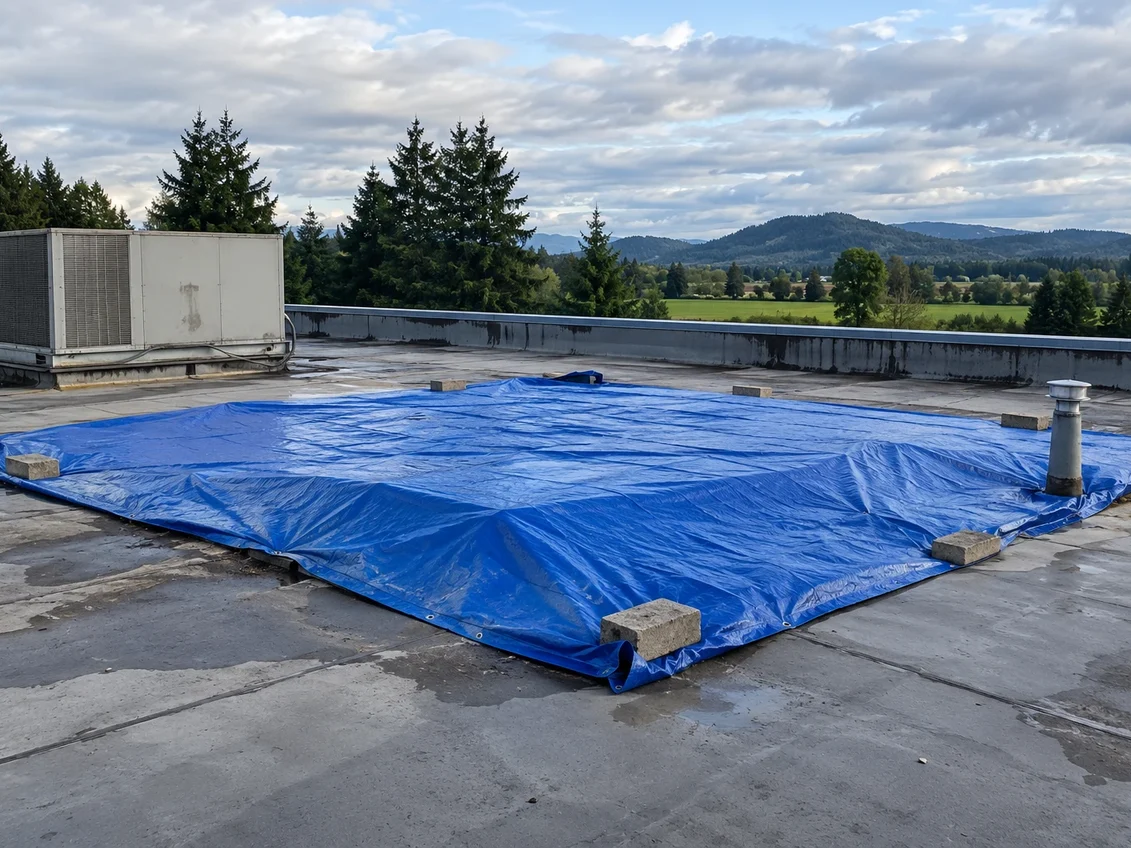
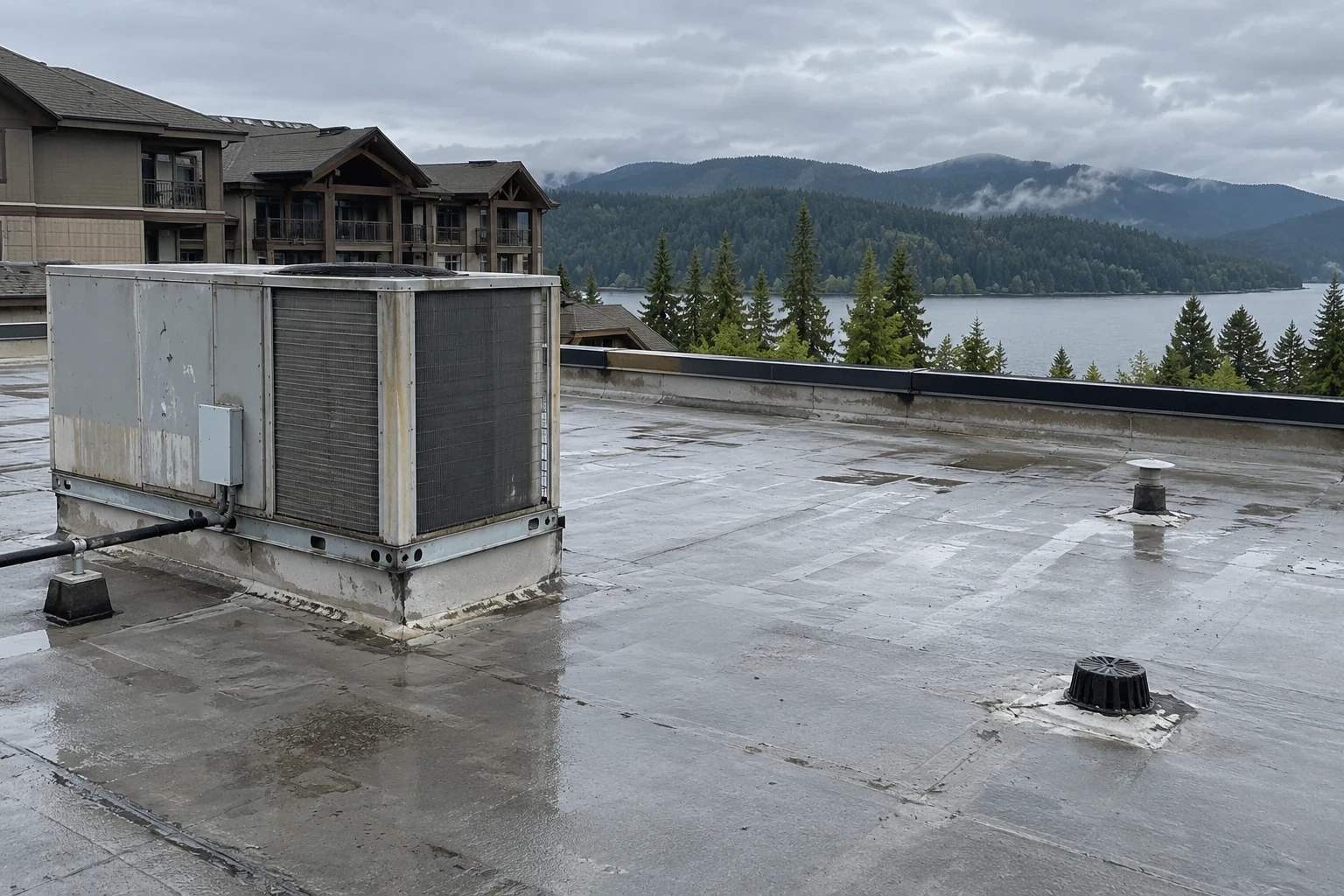
The roof is crowded. Mechanical sets units on curbs. Electrical runs conduit. Plumbing penetrates for vents and drains. The roofer flashes everything. The best order is roofer on the field, trades next, roofer again to close every opening. A roof walked by six trades before final flashing leaks.
We attend the pre-roofing meeting, mark curb locations on the deck and review equipment curbs and supports with the mechanical sub. We return after each trade to inspect and repair. Protection boards go on walk paths. Daily logs record what was installed, what the weather did and who walked where, so a later leak traces to a cause without a fight.
Unit prices cover add and deduct work. Additional tapered insulation per square foot. Extra pipe boots each. The GC adjusts the contract as the design shifts without a new proposal every time.
What is being built
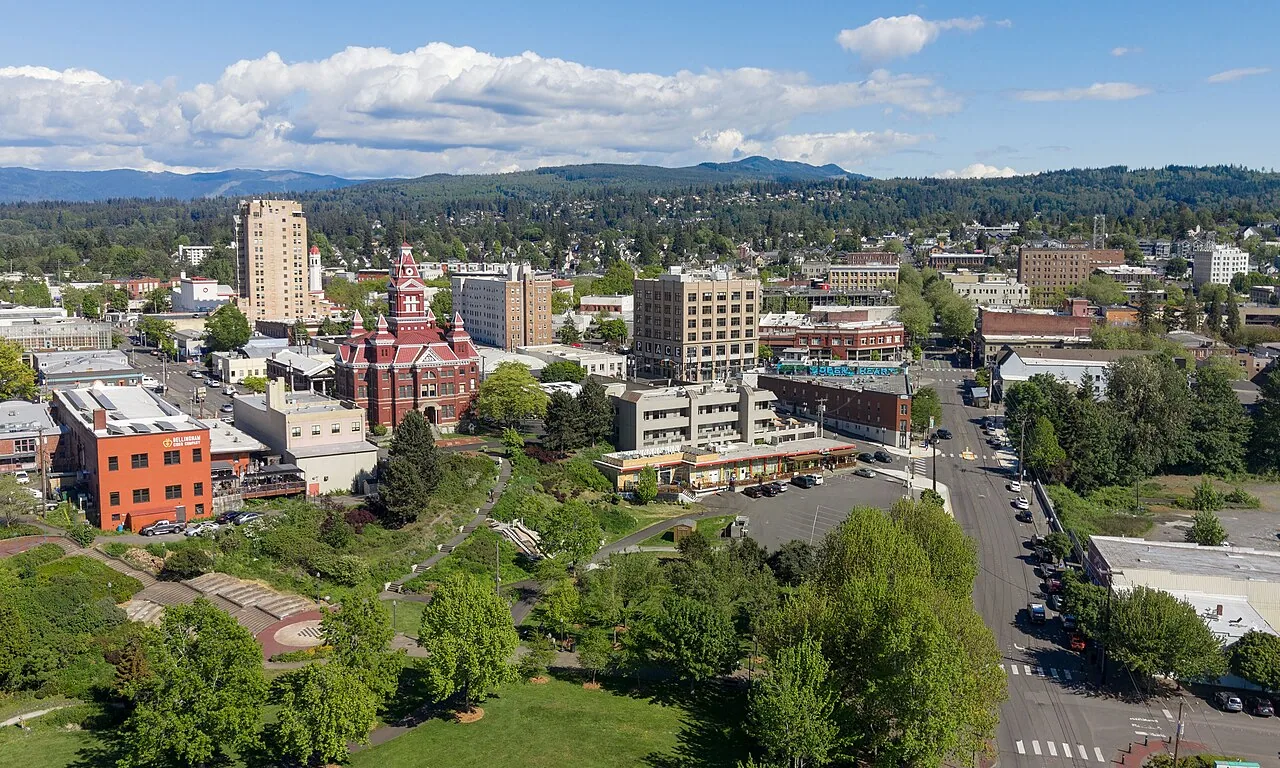
The waterfront is the large one. The former Georgia-Pacific pulp mill site, on the downtown Bellingham waterfront, is being redeveloped into a mixed-use neighborhood, with 19 acres under Harcourt Developments. Mixed use tends to mean many penetrations and tight sequencing. Tenant work can reach rooftop equipment around Bellis Fair, the enclosed center of roughly 773,000 square feet beside the I-5 and SR 539 interchange. The Port of Bellingham runs industrial parks. Older light-industrial buildings, where at least 15 breweries sit, often bring tenant improvements.
For warehouse roofs we focus on speed, drainage and uplift. For renovations we tie into old roofs without compromising them. For tenant improvements in occupied buildings, occupied building reroofing methods keep the rest of the building running.
Tenant work is the quiet part of the market. A new tenant moves rooftop equipment, adds a vent and cuts a curb. We price those as unit lines. A boot. A curb. A cricket. The GC sees the total before the trade arrives.
Wind on the bid
Perimeter fastening goes on every bid. Bellingham's March 2016 gusts reached 67 mph. The November 2024 bomb cyclone then brought damaging easterlies to Sudden Valley and prompted 22 storm incidents. A new roof with a weak edge is a claim in waiting.
We price edge metal and perimeter fastening by the foot, record the pattern on the roof plan and test it at the punch walk. The closeout file includes roof warranty management papers, as-built photographs, a roof plan showing penetrations and drains, and a first-year inspection date. If a leak appears in the first months, we trace it and tell the GC what we found: the roof, another trade's penetration or something else. Plain tracing protects everyone.
Hand-off includes training. We walk the owner's maintenance staff over the roof and show them the drains, the access points and the places not to step. A one-page care sheet stays with the building engineer. That short visit prevents the first-year foot-traffic damage that otherwise lands on the installer.
Commercial Roofing Questions
Do you bid from drawings alone or walk the site?
Both. Drawings give the base scope. A site walk finds access limits, crane locations and existing conditions that move price and schedule.
How do you handle weather delays on a tight schedule?
Sections stay small so the roof can close each day. We report forecast risks early and track real working days against the calendar.
Who pays when another trade damages the membrane?
Whoever causes it. The roofer repairs it and records the cause. Daily logs and protection boards make the origin plain.
Can you sub on public projects?
Public work carries its own bid, bonding and wage rules. We read them before pricing. The documents match the ones in our public agency work.
What do you need from the GC to start?
A released submittal, a clear deck, access for lifts or cranes and a safety contact. With those, mobilization follows within the agreed window.
Send drawings, the roof spec and the target dry-in window
Send the drawings, the roof specification and your dates. We will mark every termination and metal line and price the package before the bid closes.