Senior Living Roofing in Bellingham, WA
Senior living roofing in Bellingham, WA: quiet-hour tear-off phasing, exhaust and penetration details, perimeter fastening and dry-in days priced as bid lines.
Senior Living Roofing in Bellingham, WA
Senior living roofing in Bellingham, WA: quiet-hour tear-off phasing, exhaust and penetration details, perimeter fastening and dry-in days priced as bid lines.
Property Types We Roof
Senior Living Roofing in Bellingham
A tear-off over a memory care wing has a noise limit and a start time. Both go on the bid. Residents nap, eat and sleep under the roof we are removing. Staff need hallways clear. Families visit on weekends. A reroof on a senior living building in Bellingham, WA is a schedule problem first and a membrane problem second.
The membrane is the easy part. The calendar is not. Rain in Bellingham comes to 34.8 inches a year under about 1,866 hours of sun. Real dry-in days are scarce. We plan each section so it is closed before the day ends. We price quiet hours, section size and daily dry-in as separate lines. The operator sees what the constraints cost.
Overview
Senior Living Roofing
Residents set the hours
We ask the administrator for three things before the bid. Quiet hours. Meal times. Move-in or transfer dates that cannot slip. Those answers set when the crew can run loud equipment.
A tear-off saw over a bedroom wing is not a morning job. Plans change. A section over a dining room may start after lunch cleanup. We write the daily window into the schedule. Late starts cost crew hours. Early stops cost production. Both show on the bid, because a shorter day means more days on the roof. The operator can then trade hours against duration with real numbers in hand.
Deliveries follow the same rule. Trucks do not block the drop-off lane or the ambulance bay. Material gets craned in at a time that suits the staff.
Weather gets a vote too. If rain is forecast by two in the afternoon, the open section shrinks. We would rather strip less and close tight. A half-open roof over a dining hall in a Bellingham November is the wrong bet.
Kitchens and laundries load the roof
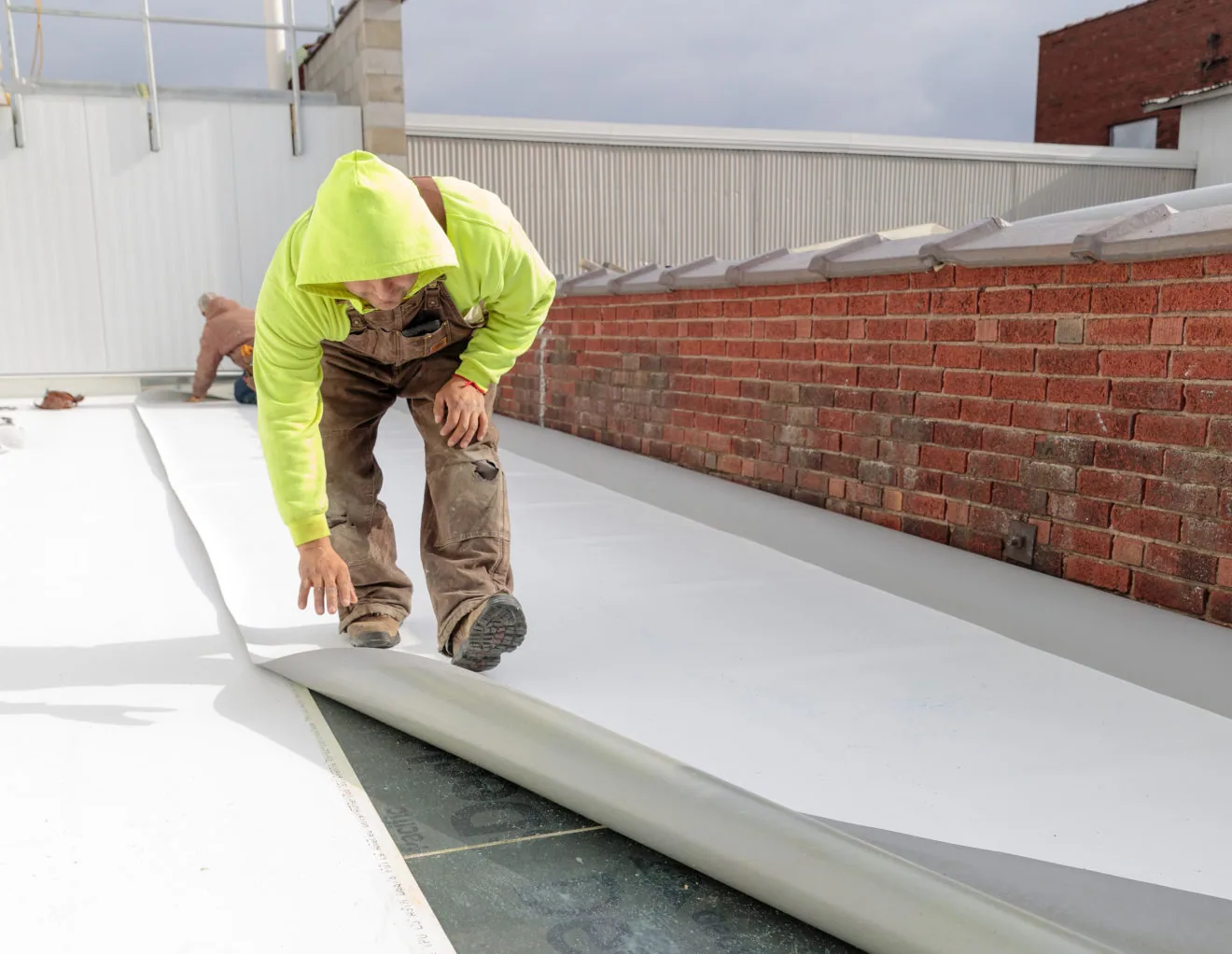
A senior living building runs a commercial kitchen and often a laundry. Both put exhaust on the roof. Grease vapor settles on the membrane near the fan. Some membranes tolerate it. Some do not. Near a kitchen hood we look at PVC for its grease resistance, and elsewhere a white TPO sheet does the field work.
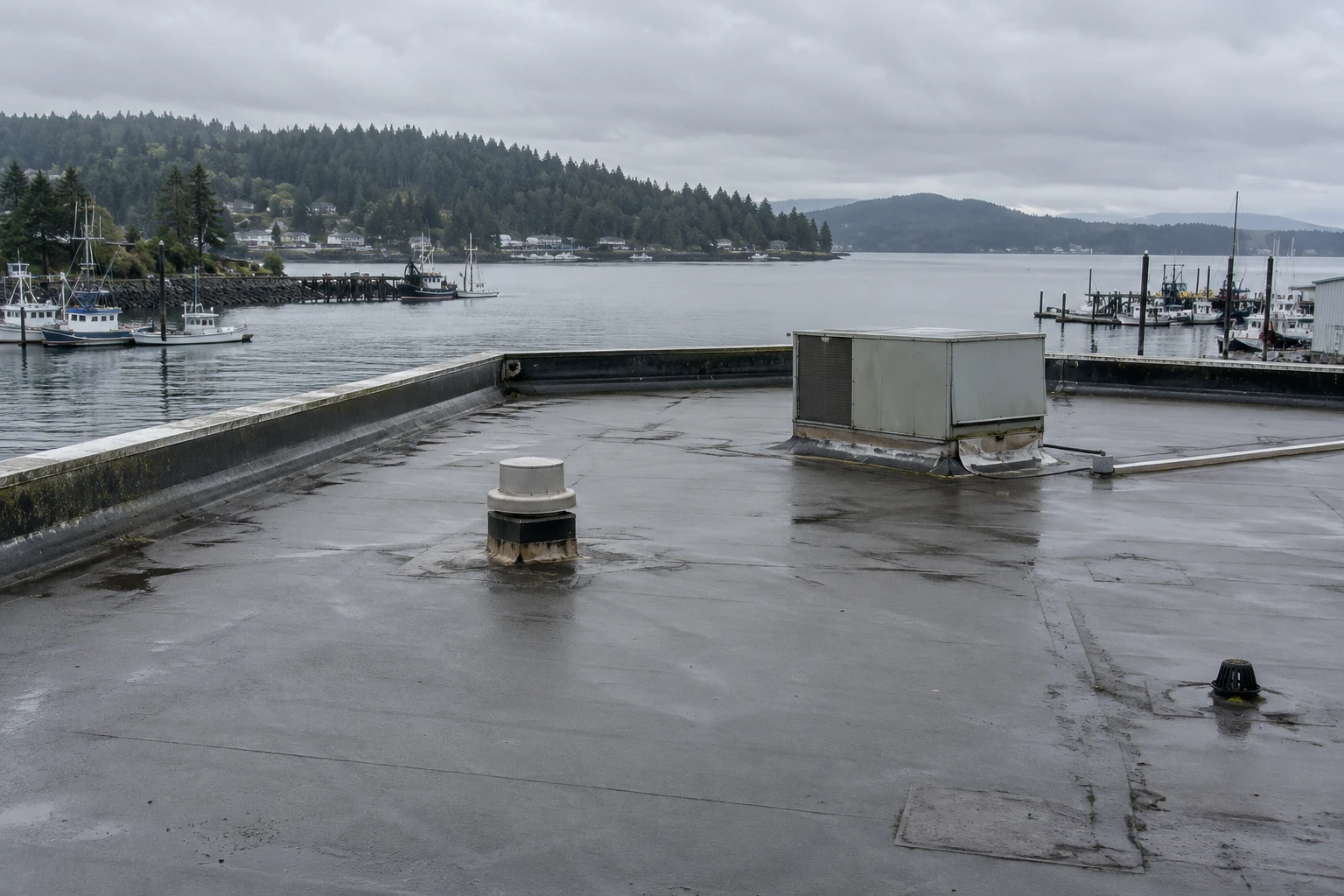
Every fan, vent and flue is a penetration. Each one gets a curb or boot and a counterflashing. We list them one by one. A building with forty penetrations prices differently from one with ten. Curbs for rooftop units are a separate item under rooftop equipment curbs and supports. If a unit must be lifted to raise a curb, the HVAC trade comes into the sequence and the bid carries a crane day.
Open flame is a permit question
Torch-applied roofing needs a hot-work permit and a fire watch. On an occupied care building, the owner and the insurer both have opinions. We usually price hot-air welded or adhered systems and leave open flame off the bid. If a detail needs a torch, it carries its own line and its own watch time.
Fire doors and smoke dampers matter at roof level, too. Penetrations through fire-rated assemblies need the right firestop. We note where the existing roof crosses a rated wall and ask the GC who holds the firestop submittal. The answer goes in the closeout binder, because an inspector may ask for it years later.
A leak is a care event
Water in a resident room means moving a resident. Staff relocate a bed, notify a family and log the incident. That cost lands on the operator, not on the roof budget, and it is why leaks on these buildings get priority response. Dry-in calls are answered at any hour, holidays included. A dry-in call under emergency roof repair starts with a tarp, a photo set and a call back to the administrator within the hour.
The best leak control is a maintenance visit before the wet season. We clear drains, check sealant and photograph every curb. A scupper blocked in October becomes a ceiling stain in November. November is Bellingham's wettest month.
A senior living roof deserves the same discipline as the healthcare roofs around PeaceHealth St. Joseph Medical Center, the city's largest employer. We keep a contact sheet on site with the administrator, the maintenance lead and our dispatcher, and we test it before the first tear-off day.
Wind finds loose edges
The November 19 and 20, 2024 bomb cyclone brought unusually damaging easterly winds. At least 16 homes in Sudden Valley were damaged, and the South Whatcom Fire Authority logged 22 storm incidents. Gusts of 67 mph in March 2016 tore stucco off a Bellingham storefront. Edges fail first. Perimeter fastening goes on every bid.
For a building near Sudden Valley, we check coping caps, drip edge and base flashing before the first storm of the season. A cap that lifts a quarter inch lets wind under the sheet. We price edge metal as its own line so the owner can see the cost of the corners.
The same check applies to a building in Cordata or Ferndale along the I-5 corridor, where open ground gives wind a long run at the roof edge. We photograph each cap and each drip edge on the first visit, then compare after every named storm.
The energy code changes the build-up
Since March 15, 2024, a tear-off statewide has had to meet the 2021 building codes and the 2021 Washington State Energy Code, insulation requirements included. That can raise the roof edge and the parapet height. Taller edges mean wall work and a different flashing detail. Those items go on the bid with their reasons.
We price the assembly the code requires and show the alternate that exceeds it. Extra insulation also helps a building that heats its residents all winter. The owner decides which line stays in. Owners who also manage a clinic can compare the same build-up against a medical office roof or a hospital roof under the same code cycle.
Cover board gets its own line as well. It protects soft insulation from foot traffic during the long wet season, and it gives the membrane a flat bonding surface. On a roof that carries maintenance traffic to kitchen fans every week, it earns its cost.
Closeout takes a punch walk
At the end, we walk every section with the administrator and the GC. Each item gets a name, a photo and a date. Drains flow. Curbs are sealed. Sealant is tooled. Debris is gone from the roof and the grounds.
The closeout binder holds the submittals, the photographs, the firestop records and the warranty paperwork the manufacturer asks for. Send the drawings, the roof spec and the quiet-hour schedule, and we will price it before the bid closes. Residents will not see the work. They will notice if it goes wrong.
Commercial Roofing Questions
How much does quiet-hour phasing add?
Shorter work days mean more days on the roof. The bid carries the extra crew-days as a separate line, so the operator can weigh them.
Which membrane suits a kitchen exhaust zone?
Grease exposure points toward PVC near the hood. The field can stay TPO if the owner wants a lower first cost.
Can a reroof run while residents stay in place?
Yes, with sections sized to close each day and noise limits written into the schedule.
What does the 2021 energy code change on a tear-off?
Insulation thickness. A taller assembly raises flashing heights, and the wall work behind that goes on the bid.
Who holds the firestop submittal?
The GC or the building owner, depending on the contract. We note every rated wall the roof crosses.
Send the drawings and the quiet-hour schedule
Send the roof plan, the spec and the quiet-hour schedule. We will return a priced scope with each termination, metal line and phasing day broken out, so the owner decides what stays in.