Commercial Roofing in Skagit Valley, WA
Commercial roofing across Skagit Valley, WA: farm, packing and processing roofs, long metal runs and a work calendar set around bloom and harvest.
Commercial Roofing in Skagit Valley, WA
Commercial roofing across Skagit Valley, WA: farm, packing and processing roofs, long metal runs and a work calendar set around bloom and harvest.
Service Areas
Skagit Valley in Bellingham
A harvest does not wait for a roof. Skagit Valley, WA is a center for tulips, blueberries and strawberries, with over 500 acres of tulips, and I-5, SR 9 and SR 20 are its major highways. Farm, packing and storage buildings on that ground work to a calendar the weather and the crop set, and a roof job has to fit the gaps in it.
Roofs on agricultural and processing buildings have needs of their own, and we plan the work around the season so a shed stays dry when the crop comes in.
Overview
Skagit Valley
The crop calendar rules
Bloom brings visitors. Harvest brings trucks, crews and cold storage running hard. Packing buildings, stands and storage sheds all have a peak, and a roof crew in the way during the peak costs the owner more than the roof job saves.
The quiet weeks are the window. Late summer and fall can open between crops, and winter offers gaps for repairs. The wet season narrows the options. Rain in Bellingham, the market city, totals about 34.8 inches a year, with the heaviest month November and the lightest July, and Skagit has weather of its own, so the schedule carries float.
We ask for the crop calendar on the first call. A building needed in June for fruit may be idle in October. We pick the weeks the building can spare and size the work to finish inside them.
Roof work also needs the owner's attention at the right time. A decision on repair or retrofit made in July can be installed in September. A decision made in November waits for spring. We give owners a decision date for each building, working backward from the window they want, and we tie it to the material lead time.
Long metal runs and fasteners
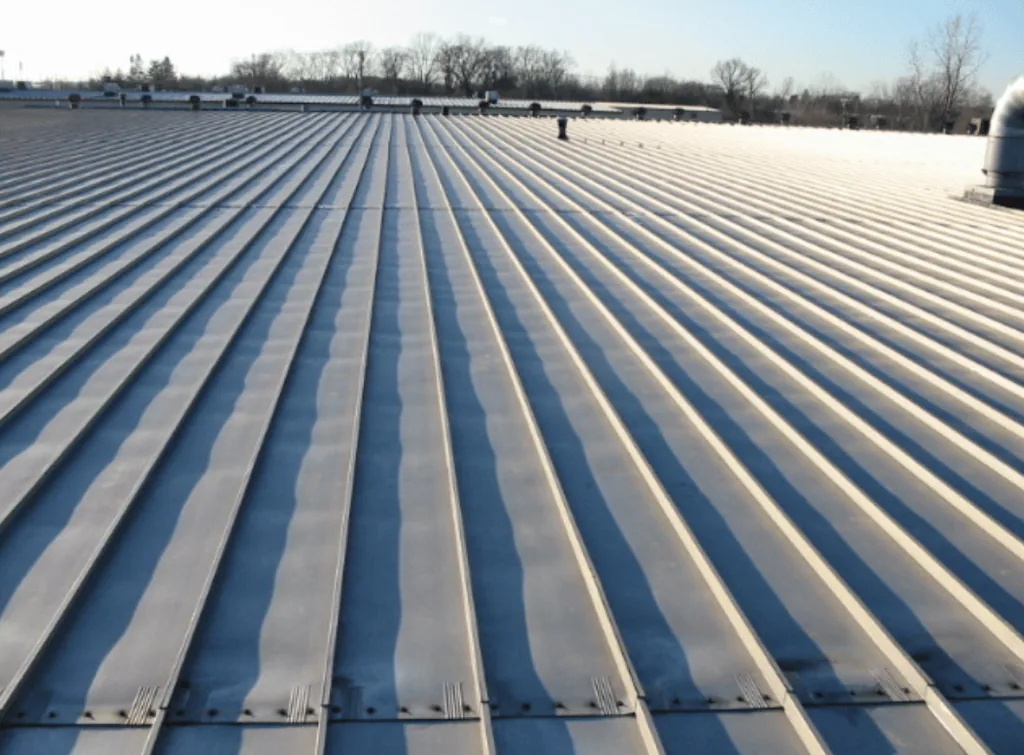
Farm and packing buildings often wear long metal roofs, and the walk looks for the usual failures. Screws back out of exposed-fastener panels. Laps open. Rust starts at cut edges and in low spots. A loose-fastener count per panel row tells us whether the roof wants repair or retrofit. A sound hole takes a re-driven screw, and a stripped one takes an oversize screw or a fresh spot with a new washer. Restoration keeps the old panels: failed fasteners come out, laps get sealed, the surface is cleaned and a coating goes on. A metal roof retrofit puts new framing and panels over a roof whose metal is too far gone, and the choice follows panel condition, deck moisture and how long the building must last.
Penetrations get their own walk. Vent stacks, skylights, ridge vents and conduit each leak at a boot or a curb, and cracked boots and dried sealant turn up first. We replace boots, reseal curbs and note any glazing that has clouded. The fix per item is small, and the count moves the price. Foam or rubber closure strips at ridge and eave are another soft spot, since they compress and crumble over time and let wind-driven rain in, so we replace them as a set.
Condensation looks like a leak
Cold metal over warm, humid space sweats. Washdown, produce handling, animals and cold rooms all push moisture upward. The moisture condenses on the underside of the panel and drips. The owner sees water inside and blames the roof.
We check the underside before we call a seam bad. Dry-weather drips point to condensation. Drips that follow rain point to a leak. The fixes differ: insulation or a vapor control layer for condensation, flashing and fasteners for a leak.
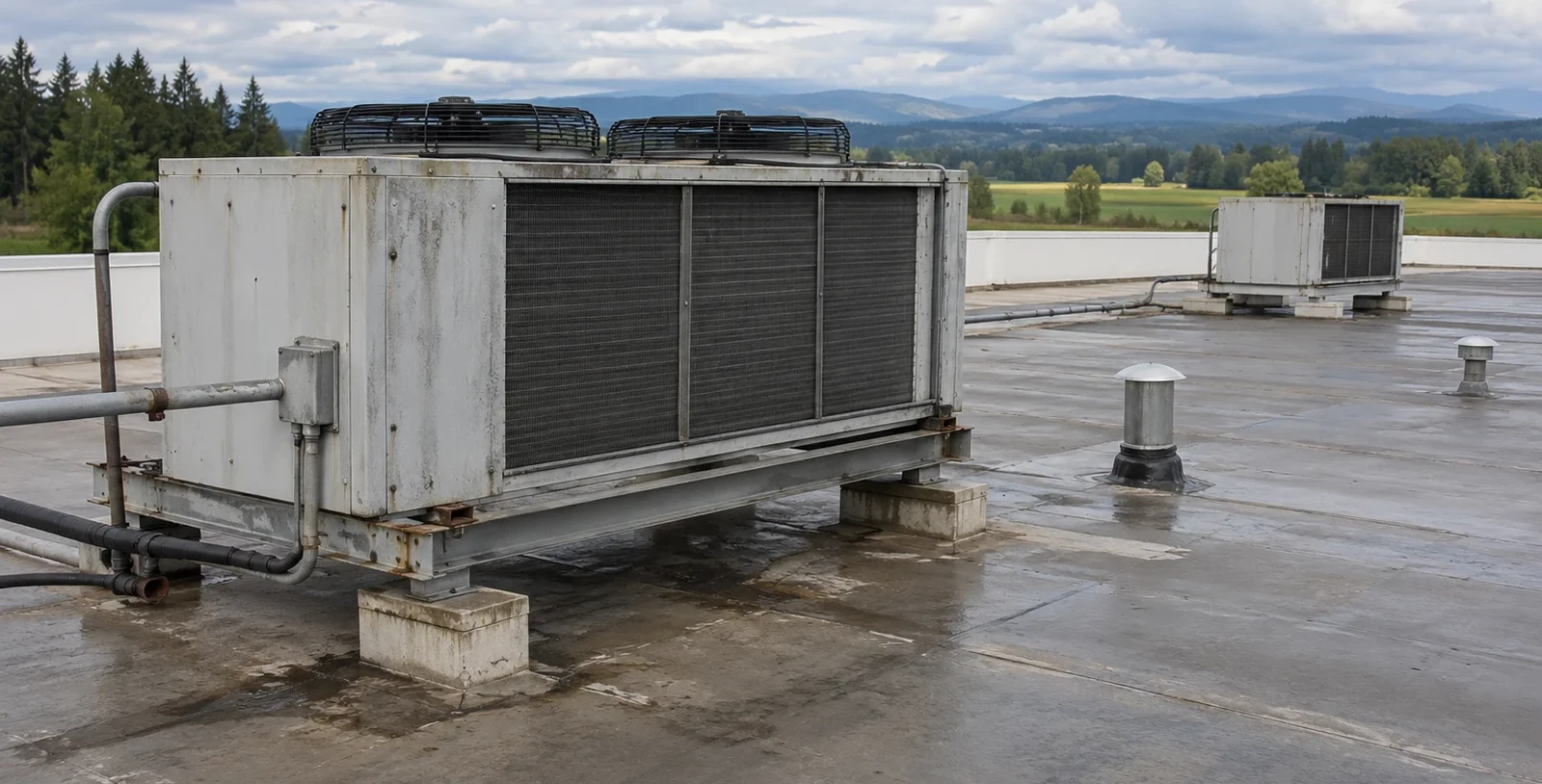
A building that houses cold storage or processing space adds another question. Refrigeration load pushes heat out through the roof, and roof insulation affects that load. A cold storage roof deserves its own insulation plan, and the energy code applies on a replacement.
Ventilation is a roof partner. Ridge vents, gable vents and exhaust fans move moist air out before it reaches the cold panel. A blocked vent turns a small condensation problem into a daily drip. We check the vents and tell the owner which ones need clearing, and we recommend added vents where the plan lacks them.
Wind, snow and gutters
Open farmland gives wind room to run. Bellingham saw 67 mph gusts in March 2016, and a bomb cyclone in November 2024 sent easterlies across the region. A valley with few windbreaks sees its own gusts, and roof edges catch them first.
We check ridge caps, rake trim and eave metal for loose fasteners. We fasten at close spacing where the spec calls for it. A loose rake on a long metal roof is how wind finds the panel edge.
Snow is light in the lowlands, with Bellingham averaging roughly 10 inches a year, mostly December through February. Gutters and downspouts still take sliding snow. We strap them on close centers and check the discharge points.
Door headers and wall-roof joints take rain driven sideways. Tall doors on storage and packing buildings leave a long joint that sees wind and water. We check the flashing, the sealant and the fastener heads along each header. A door that flexes in a gale can open a gap that sealed tight when new.
From the highway to the field
The valley's buildings spread along I-5, SR 9 and SR 20 and the roads between them. Skagit Transit connects the valley to Bellingham, Everett and Whidbey Island, which tells us people and goods move through it. For a roofer, spread means drive time, and we price it as a line.
Where several sites sit on the same road, we run them as a route. Mount Vernon, Burlington and La Conner sit within one corridor. Grouping the work cuts travel and mobilization costs.
A multi-site program gives owners of several buildings one standard, one schedule and one record.
Our maintenance visits keep small items small. Between crops, a crew can clear gutters, re-drive loose screws, replace cracked boots and reseal curbs on several buildings in a day. Those visits cost far less than a leak during harvest.
What drives the number
Roof system and condition set the base. Fastener and panel replacement counts add lines. Access over open ground adds more, since crane and lift pads need firm footing. The calendar changes the rest, and a roof finished in the dry months costs less than one fought through in the wet.
Code enters a replacement. A replacement picks up the insulation levels of the 2021 energy code, in effect since March 2024, and the added height gets its own line in the estimate.
Commercial Roofing Questions
How do you schedule around bloom and harvest?
We ask for the crop calendar first and pick the quiet weeks. The strips are sized to finish inside them. If the weather slips, we hold rather than work into a peak.
Is it a leak or condensation?
We check the underside of the panels. Drips in dry weather point to condensation. Drips after rain point to a leak. The fixes differ.
Can an old metal farm roof be saved?
Often. Failed fasteners are replaced, laps are sealed and a coating goes over clean, sound panels. If rust has taken the metal through, a retrofit is the next option.
What does soft ground do to a crane job?
It limits where the crane can stand. We check ground bearing, lay mats where needed and book equipment early. A stuck crane costs the whole day.
Can sites across the valley share a schedule?
Yes, when the sites sit on one corridor. A single crew route carries one set of mobilization costs for the whole group.
Send the building list and the crop calendar
Send the building list, the weeks each one can spare and any past leak notes. We will price the walk, the repairs and the options as separate lines before the bid closes.