Skylight and Penetration Flashing in Bellingham, WA
Skylight curbs, pipe boots and penetration flashing for Bellingham, WA commercial roofs: base flashing height, moss-line leaks and a priced count per roof.
Skylight and Penetration Flashing in Bellingham, WA
Skylight curbs, pipe boots and penetration flashing for Bellingham, WA commercial roofs: base flashing height, moss-line leaks and a priced count per roof.
Commercial Roofing Services
Skylight and Penetration Flashing in Bellingham
A pipe boot costs a few dollars. The ceiling under it costs thousands. Every penetration on a Bellingham, WA roof is a small bid line with a large downside. The city logs about 34.8 inches of rain a year and very little sun to dry it out, so a weak boot sits wet for months before it shows. Then a tile drops on a Monday.
The fix is a count. How many penetrations, what type, what condition, what it costs to renew each. We do that count on the first visit and put the numbers on the bid. A general contractor can then decide which to renew now and which to leave.
Leak calls from penetrations also follow the weather. A boot that holds in a dry spell opens in the first storm after it. A leak repair trace often ends at a boot rather than in open field, so the count saves a diagnosis later.
Overview
Skylight and Penetration Flashing
The penetration count
We walk the roof and list every hole. Pipes. Vents. Conduits. Exhaust stacks. Hatches. Skylights. Antenna mounts. Equipment posts. Each gets a type, a flashing material and a condition grade.
Old roofs carry dead penetrations. Capped lines. Abandoned vents. Former equipment pads. Each is a liability. Removing a dead penetration and infilling the deck costs less than maintaining its flashing for ten years. We mark those on the plan and price removal as a separate line. The count then gives the owner a priority order: renew what is failing, remove what is dead, watch the rest.
Photographs make the count usable. Each penetration gets a close shot and a wide shot, tagged to the plan. The report lists them in order of risk. Failing first. Aging second. Sound last. Pricing sits beside each entry. The owner can approve the first group in an afternoon.
Base flashing height
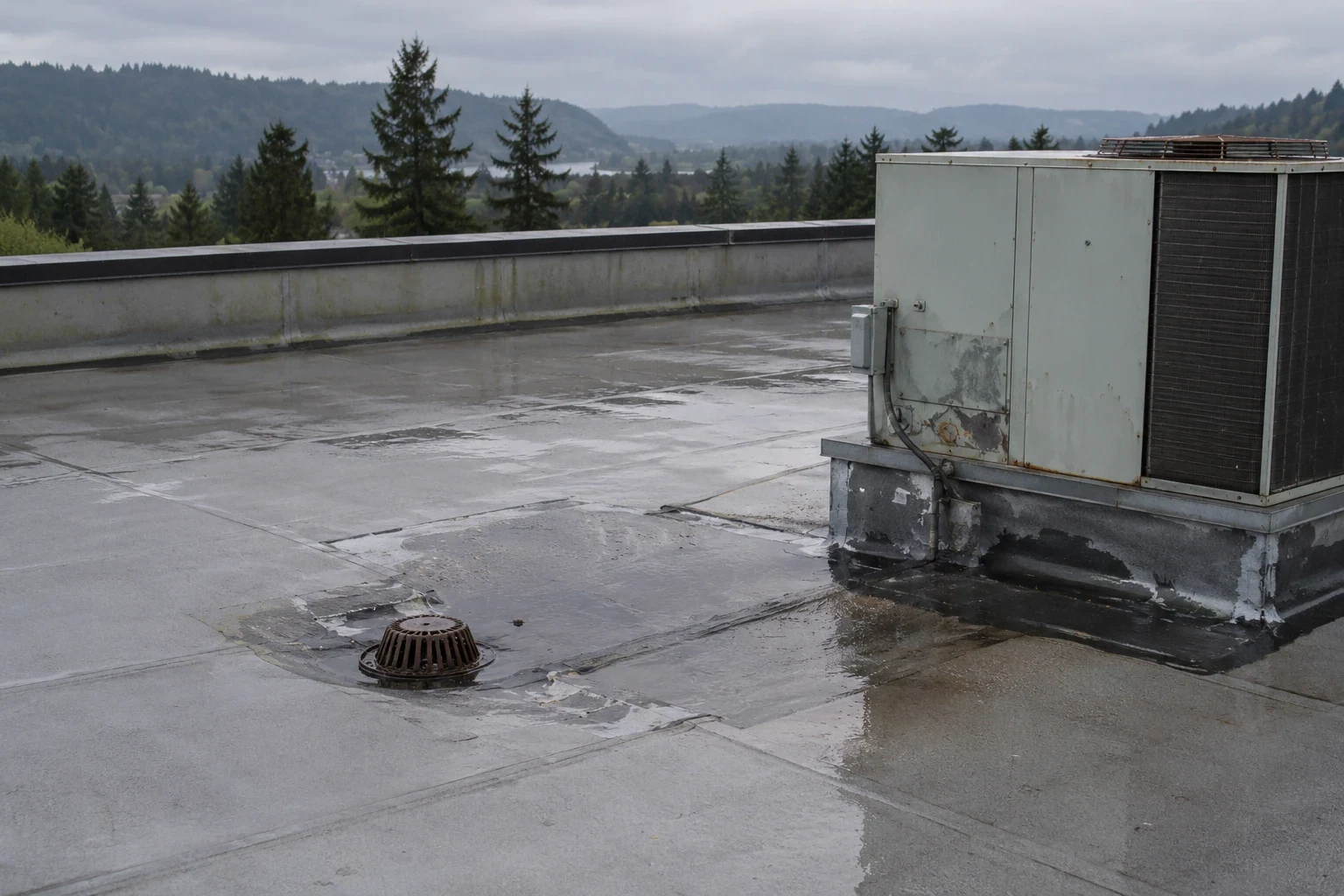
Height is the detail most often missed. Base flashing on a curb or a wall needs enough rise above the roof surface to stay clear of ponding and snow. Too low, and standing water reaches the termination. Snow averages roughly 10 inches in Bellingham, mostly December through February, and a low flashing at a skylight curb sits in the melt.
We measure from the membrane surface to the top of the flashing. Where it falls short, we raise the curb or extend the flashing. That adds a line to the bid. It is cheaper than a repeat leak. Added insulation thickness changes height too, so we check it when a reroof raises the roof surface under Washington's 2021 energy code, effective statewide March 15, 2024.
Snow load matters at skylights. A curb holds snow on its uphill side, and melt then sits against the flashing. A saddle or cricket behind the curb sends it around. Without one, the same corner leaks each winter. We list the cricket on the bid.
How these details fail
Rubber boots crack where they bend. Sealant loses its stretch and pulls from the joint. Metal flashing opens at its laps. Collars loosen around the pipe as it moves. Moss grows in the joint and lifts the sealant bead.
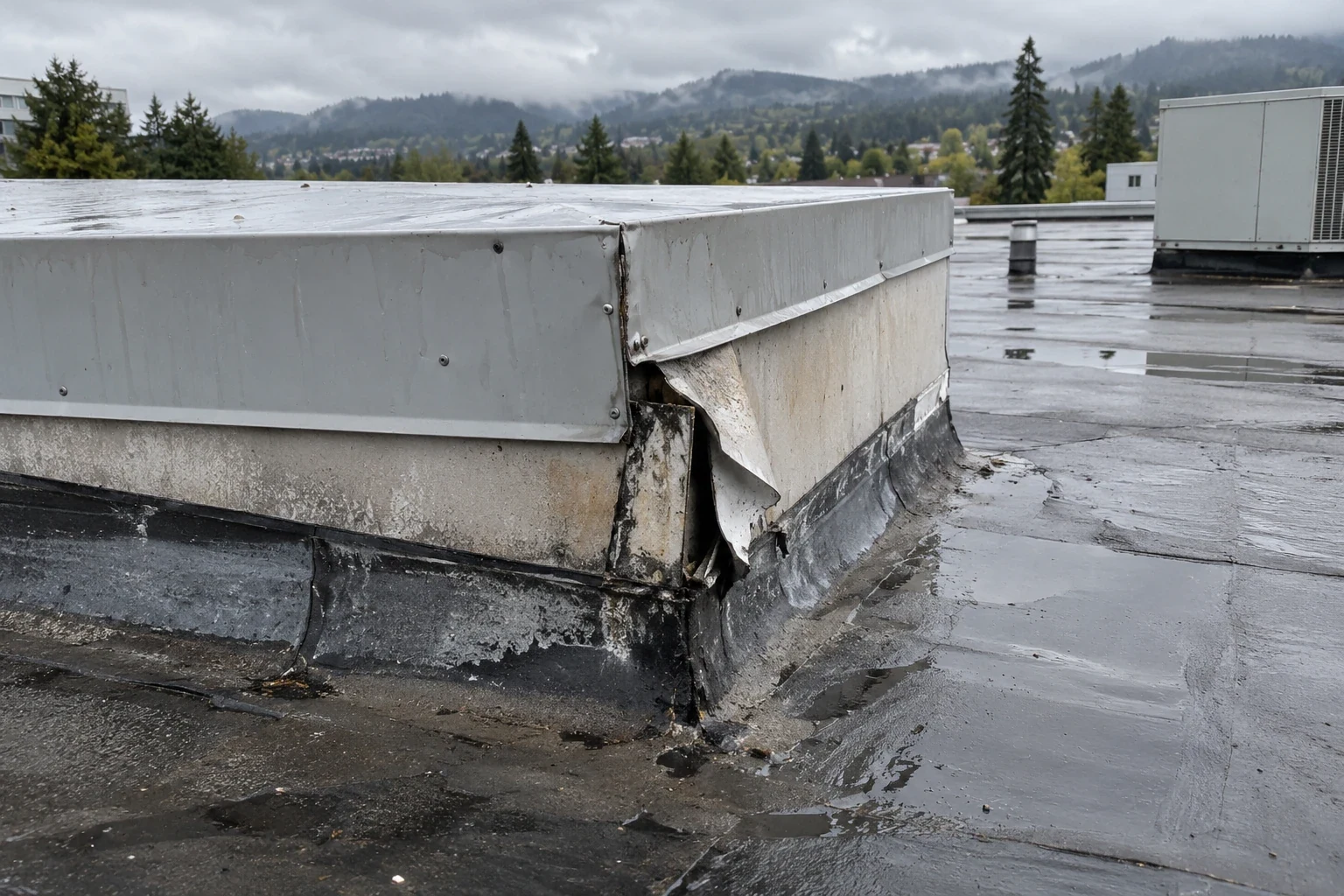
Skylights fail differently. Domes craze and yellow. Gaskets shrink. Curbs rot at the corners where water collects. Condensation inside a unit looks like a leak. We test before repairing. A dry interior with a stain at the curb corner points to an exterior failure. Beaded moisture on the glazing points to interior humidity. The wrong diagnosis costs a repair that does not work.
Material compatibility is a quiet cause of failure. Some sealants attack single-ply sheets. Some metals react with one another. We choose resins, tapes and fasteners that suit the membrane under them. We do not use whatever is on the truck. Photographs of each repair go into the owner report.
Renew, rebuild or remove
Minor failures get a new collar or a bead of compatible sealant and a stripped-in patch. Pre-formed boots matched to the membrane beat hand-built details. They bond cleanly to a TPO or similar single-ply sheet.
When flashing is brittle, we replace it. Rotted curbs are rebuilt with new blocking and flashed into the membrane in one continuous detail. A worn skylight unit gets replaced, not patched, when the glazing is crazed or the frame is racked. Unwanted skylights get removed and infilled with framed deck and membrane. That is a lasting fix, and it removes a future leak. Every new detail sheds water around the penetration. A flashing that ignores the slope behind a curb fails again, which is why flashing failure repair starts with the slope.
Skylights add daylight and heat loss. Under Washington's 2021 energy code, effective statewide March 15, 2024, a replacement unit may need a certain performance rating. We check that before ordering. Fire-rated smoke vents and access hatches keep their rating when replaced, and any change goes through the building's fire-protection contractor.
Sequencing with the trades
Penetrations belong to many trades. Plumbers add vents. Mechanical adds curbs and conduit. Electrical adds mast heads. Each one cuts the roof. The roofer flashes it. The order matters. Roofer first on the field. Trades second. Roofer again to close every opening.
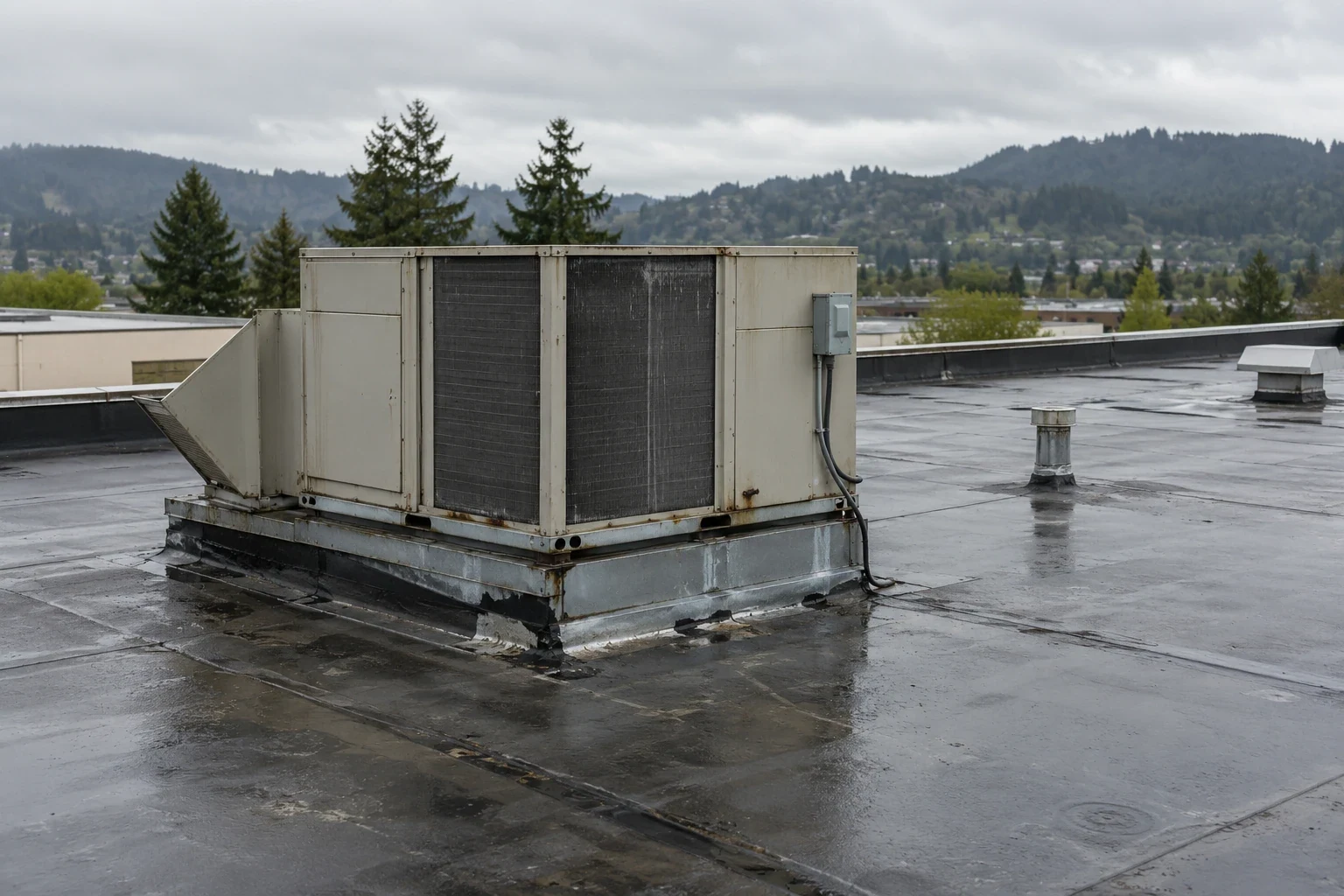
We attend the pre-roofing meeting, mark penetration locations on the deck and review curb details with the mechanical sub. Equipment platforms follow the same rule, down to the curbs and supports under each unit. After each trade we inspect and repair. At closeout, a punch walk checks every boot, collar and curb against the count. Any penetration added later by another trade is logged, so the next owner knows what changed.
Pricing a reroof around many penetrations is simpler with the count in hand. Each boot, each curb and each hatch has a unit price. The total stops being a guess. A change order for an unseen penetration is priced at the same unit rate, so there is no argument at the dry-in.
Where the count runs high
Medical use brings exhaust stacks, plumbing vents and mechanical curbs in number. Health care is a major roof user here, led by PeaceHealth St. Joseph Medical Center, the city's largest employer at about 3,116 jobs, and a hospital roof gets a tight flashing schedule. Retail around Bellis Fair, an enclosed center of roughly 773,000 square feet at the I-5 and SR 539 interchange, adds sign hardware and rooftop units.
Older light-industrial buildings, including many that breweries occupy, can carry a history of abandoned lines. Industrial space in the Marine Drive waterfront area may too. We count first and quote after.
The same attention applies at the Fairhaven end of town, and anywhere a tenant has changed use, since a change of use leaves added vents and abandoned lines behind.
Commercial Roofing Questions
Why does the skylight only leak in wind-driven rain?
Wind pushes water sideways into curb corners and under cracked sealant that stays dry in ordinary rain. The opening is small. A repair at the exact corner usually ends it.
Can an old skylight stay if I replace the flashing?
When the dome and frame are sound, new flashing and a new gasket extend the unit's life. If the glazing is crazed or the frame is bent, new flashing is wasted labor.
How high does skylight flashing need to sit?
Tall enough to clear ponding and snow melt, and to meet the manufacturer's minimum. We measure from the finished membrane, not the old one.
What happens to penetrations during a reroof?
They are rebuilt with the new membrane, not reused. Dead ones are removed and the deck infilled so they stop being future leaks.
Does moss near a boot matter?
It does. Moss holds water in the joint and lifts the sealant. We scrape it, treat the area and reseal on a dry day.
Send drawings, the roof spec and the target window
Send the roof plan and the equipment list. We will count every penetration, grade the flashing and price each renewal before the bid closes.