Seam Failure Repair in Bellingham, WA
Repair of split and open roof seams in Bellingham, WA: hot-air weld probe checks, tape and lap fixes, cold-morning limits and priced run-by-run lines.
Seam Failure Repair in Bellingham, WA
Repair of split and open roof seams in Bellingham, WA: hot-air weld probe checks, tape and lap fixes, cold-morning limits and priced run-by-run lines.
Roof Damage Repair
Seam Failure Repair in Bellingham
A hot-air weld looks closed whether it is or not. Only a probe tells the difference. In Bellingham, WA the probe check is the most useful ten minutes on a roof. Rain runs about 34.8 inches a year, November is the peak, and the seams on a membrane spend most of that time wet. A weld with a cold edge or a trace of contamination lets go the first week of a storm.
The leak that follows sits somewhere else. Water runs under the sheet and drops at a ceiling tile far from the open lap. We find the lap by probing, not by guessing, and price the repair run by run.
Wind pulls on seams from the edge in. Open laps near the perimeter often follow the sort of lift seen in wind damage roof repair work, and the November 2024 easterlies in Sudden Valley are a reminder of how fast an open lap becomes a peeled sheet.
Overview
Seam Failure Repair
How each roof joins its sheets
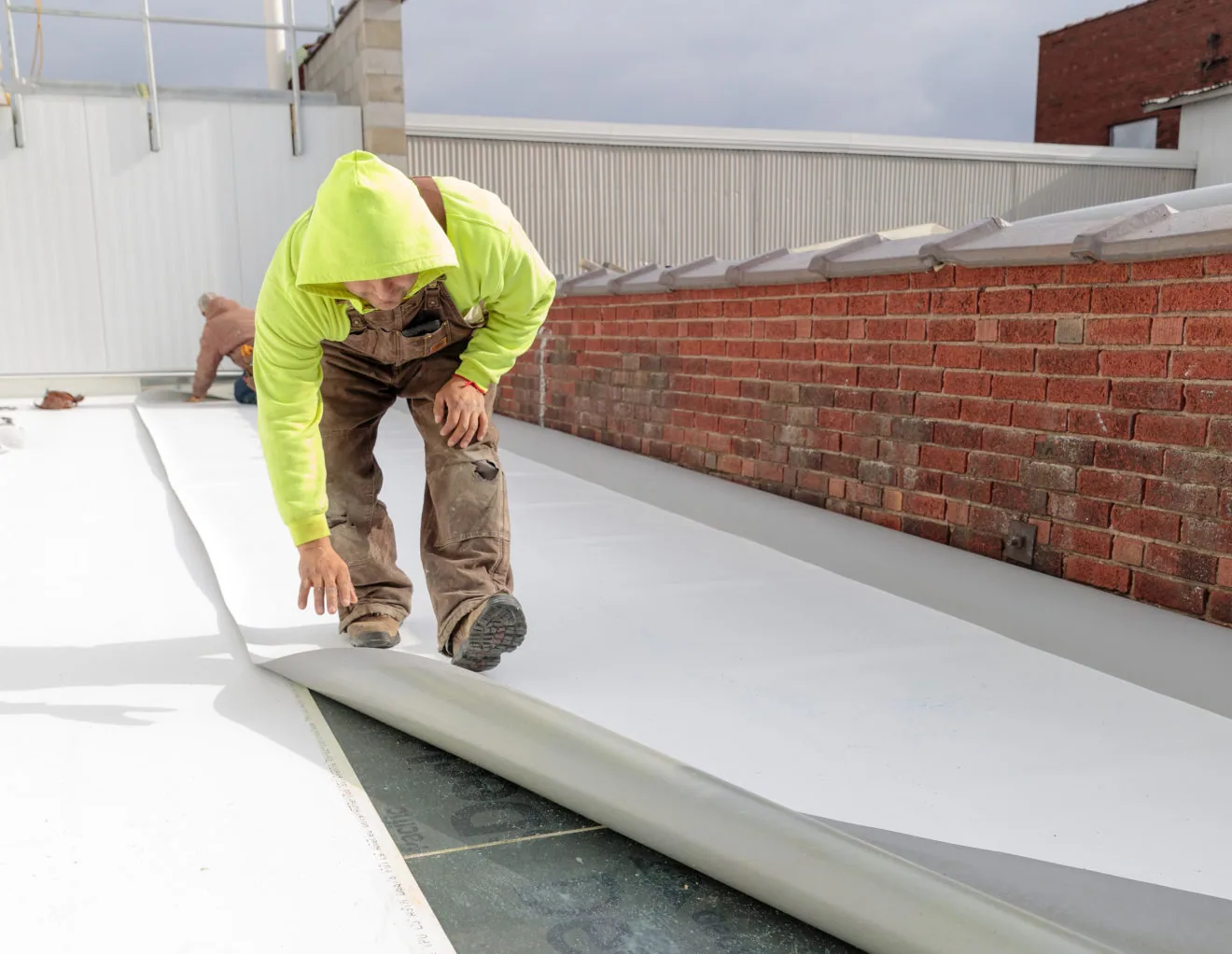
Every system makes a seam its own way, and the failure follows the method. TPO and PVC sheets fuse with hot air. A good weld becomes one piece. A bad one shows an uneven bead or a cold edge. EPDM uses adhesive tape or liquid splice, which can age and release. Modified bitumen laps are torched or cold-adhered and fail at the edges where bitumen thins. Standing seam metal panels interlock and fail at clips, end laps and sealant.
Knowing the family tells us where to probe and what material will bond. A tape repair on a welded sheet fails. A hot-air patch on aged, contaminated membrane fails. Identification comes before work.
Age changes the answer. A young welded sheet takes a hot-air repair easily because the plasticizers that make it weldable are still there. An older sheet cannot be rewelded cleanly. A repair strategy that worked in year five fails in year fifteen. The register records membrane age beside every repair so the call is made on the sheet in front of us.
The probe check
A blunt probe runs along the lap edge. A failed weld lets it slide under the sheet. A tape seam lifts with light pressure. We mark every open section, measure its length and photograph it with a scale.
The pattern matters as much as the count. Failures down one side suggest sun or wind exposure. A line of failures along a field suggests fabrication or shrinkage. Failures at crossings, where three or four sheets meet, usually mean a cold weld or a contaminated joint. We write the pattern into the report so the repair addresses the cause. Each open run gets its own bid line, with footage and price. The owner approves the worst runs first.
Shrinkage shows too. A membrane pulled back from a wall or curb has been under tension, and its seams in that zone are the most stressed. Gaps at the perimeter, bridging over inside corners and fasteners that have pulled through all point to movement, not workmanship.
Cold mornings and damp decks
Seam work is weather work. A weld on a damp sheet steams and fails. Tape on a cold surface does not set. Bellingham logs about 1,866 hours of sun a year, so a surface that looks dry at nine can still hold film at ten. We read the surface before welding, wipe it, and wait if it reads wet.
July is the driest month and the best window for permanent seam work. Winter repairs are temporary. A cap strip or a sealed patch holds a seam until the weather allows a weld. The record shows which seams got a temporary fix and which got the permanent one. A freeze after a thaw can reopen a seam, so temporary repairs get a second look after each cold snap.
Quality control is strict. After each weld, we probe the full length, record the result on the plan and photograph a sample. A repair that cannot be probed cleanly is redone. A seam that looks closed but is not bonded fails in the first hard rain, and the owner pays twice.
Repair methods
The standard repair cleans the surface, removes contamination and reseals with a compatible method. A hot-air weld on thermoplastics. A new splice or cover tape on rubber. A reinforced cap strip over the joint where aged membrane will not weld. Probe-tested edges are sealed. Each run ends with a termination detail so the seam does not unzip.
Aged sheet is the limit. Plasticizers leave a thermoplastic membrane over time, and it welds poorly. A cap strip or a restoration coating may be the better answer. If failures are widespread, repair stops being economical and we price a recover or replacement beside it. Open seams at a wall usually sit next to a flashing failure, and we fix both in one visit.
Long runs go in stages. Each stage is tested before the next begins. One cold joint should not spoil a day's work. Tools are kept clean, and the nozzle temperature is checked against the sheet, since a weld that is too hot burns the membrane and one too cool does not fuse.
Water behind an open seam
An open seam lets water under the sheet, and it travels. Board below may soak across a bay while the seam that fed it looks small. We scan with infrared after the seam repair is planned and cut cores where the scan is unclear. If the board is soaked, it comes out before the seam closes. Closing a seam over soaked board seals the problem in.
Moss lines near a seam show long-term wet. They mark where the lap has been taking water for seasons. We photograph them. They tell the carrier and the owner that the failure was slow, which affects how the file reads.
Fog and wet air slow the whole job. Welding on a damp surface is a lost day. The bid carries float for it, and the schedule shows where. The owner sees the finish date as a range tied to the forecast, with the dry-in day marked.
Where seam footage runs high
Large field areas carry the most seam. Industrial roofs at the Port of Bellingham's Marine Drive waterfront area and the Airport Industrial Park can have long runs of lap. Retail roofs near Bellis Fair, with rooftop units, wear seams along technician routes. Older roofs with repeated repairs carry a patchwork of seams from different years that age at different speeds.
Preventive checks pay. The maintenance visit includes a probe sample and a fix for small openings before they become runs.
A small roof with many details meets seams and flashings often, wherever it sits. Close inspection there is mostly hand work. Cost per square foot runs higher than on a broad industrial field, and the bid says so.
Commercial Roofing Questions
Can a seam be repaired without replacing the roof?
Usually, when failures are limited and the membrane near them is still flexible. Widespread splitting means the sheet is aged, and the choice becomes recover or replacement.
How can I see a failing seam from the ground?
You mostly cannot. A line of dark staining or a ripple along a joint is a clue. A probe survey is the dependable test.
Does a seam repair stay watertight through winter?
A correct weld or tape seal on clean, flexible membrane lasts. One placed on dirty or brittle sheet may fail within a season. Preparation is most of the labor.
Why do seams split at T-joints?
Several layers meet there, so the weld is thinner and shrinkage pulls from three directions. Covering each T-joint with a patch is standard.
Are metal roof seams a different problem?
They are. Standing seam fails at clips, end laps and sealant. The repair uses sealant, fasteners and sometimes panel replacement.
Send roof photographs and any leak dates
Send photographs of the open laps and the leak dates. We will probe the seams, map the failures and price the repair run by run.